
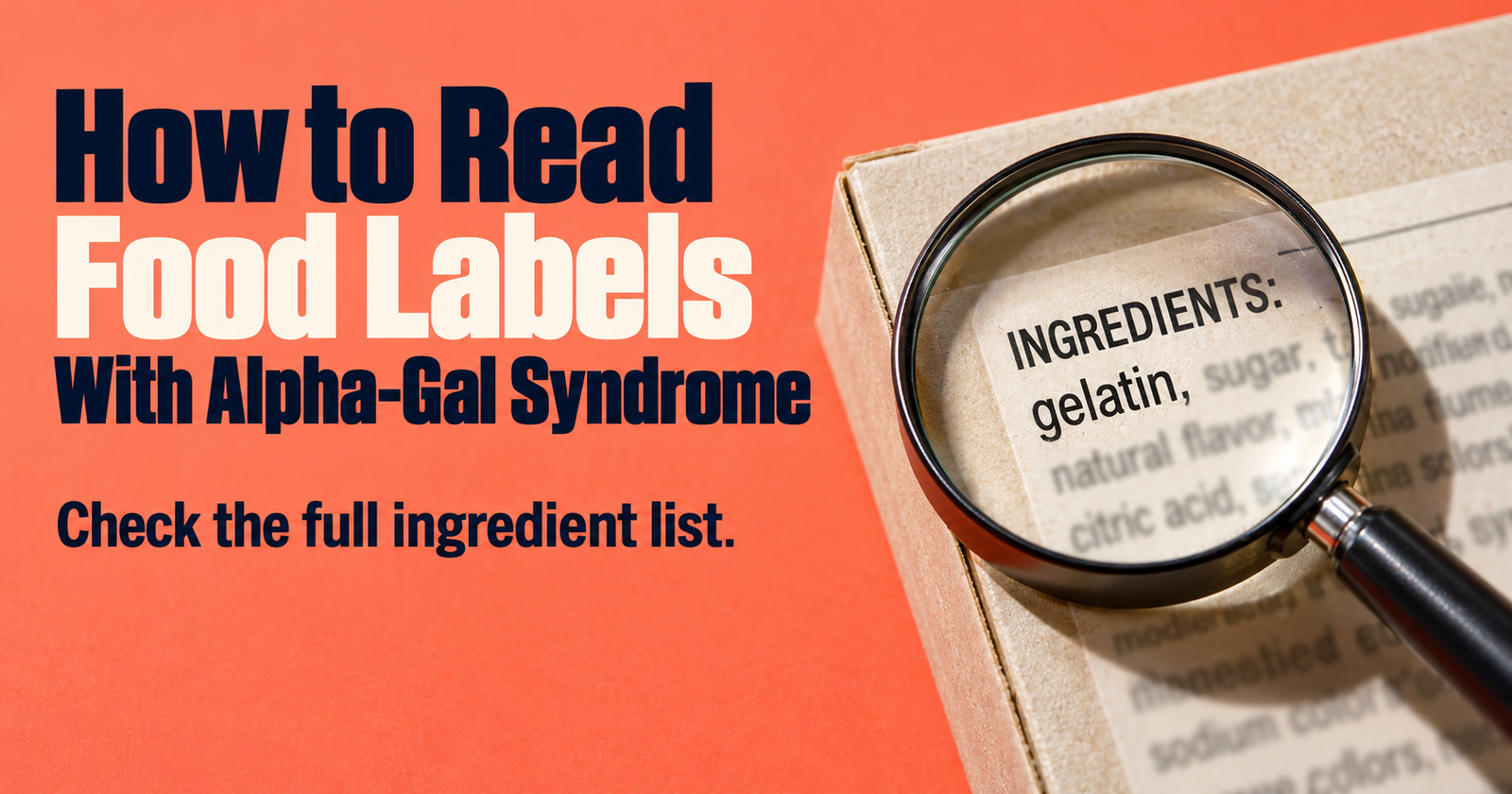
The first thing I’d change about grocery shopping with Alpha-gal syndrome isn’t necessarily what goes into the cart.
It’s how I read the package.
Before Alpha-gal enters the picture, buying a box of crackers or a bag of candy can be as simple as checking the price and grabbing the flavor you like.
Once mammalian ingredients become something you need to watch, the back of the package starts mattering a whole lot more.
And the frustrating part is that food labels weren’t designed specifically for people managing Alpha-gal syndrome.
You might see milk clearly identified.
You might see gelatin without any indication of whether it came from a pig or cow.
You might find beef broth buried halfway through a long ingredient list.
Or you might see a vague ingredient and spend ten minutes wondering whether it’s animal-derived.
My approach would be to stop treating every unfamiliar word like a threat and start checking labels in a consistent order.
That makes grocery shopping faster, more practical, and considerably less overwhelming.
The First Thing I’d Check Is the Actual Ingredient List
Not the product name.
Not the picture on the front.
Not the big advertising claims.
The ingredients.
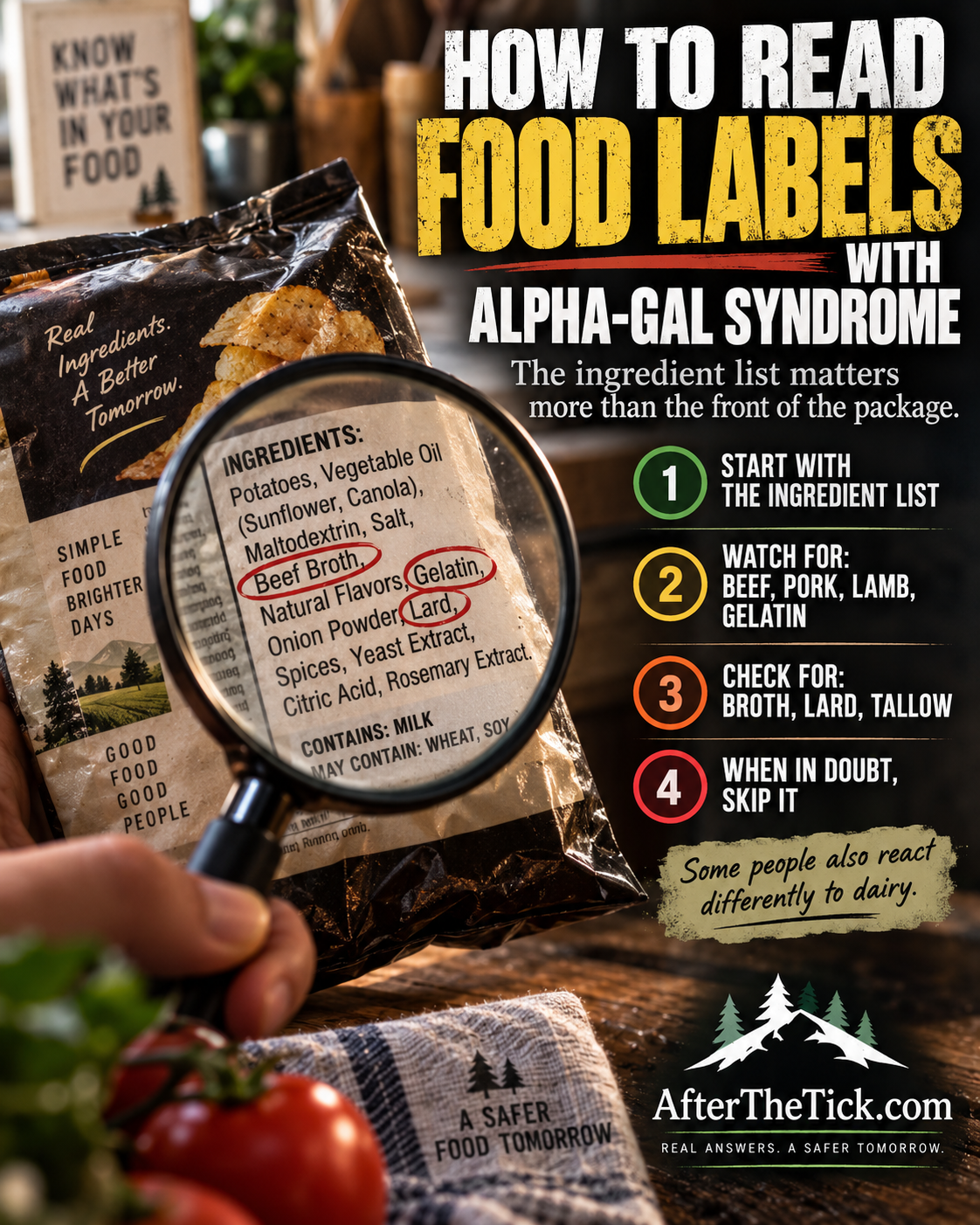
A package can say vegetable soup and still contain beef broth.
A bag of potato chips can have an ingredient list that includes dairy-derived seasonings.
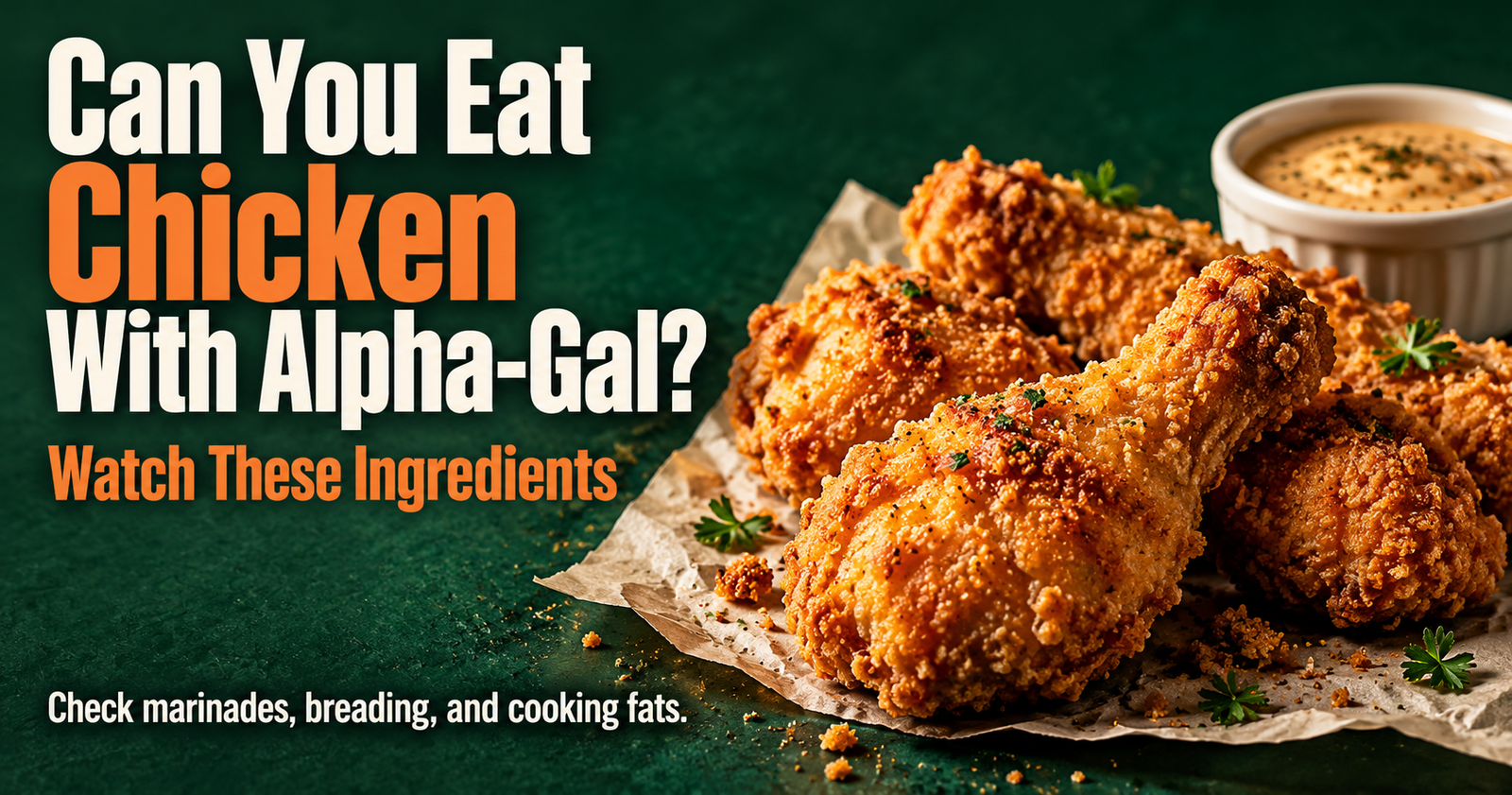
A box of flavored rice can contain chicken broth, beef stock, or other ingredients depending on the product. The chicken guide shows how broth and other additions can affect an otherwise straightforward poultry meal: chicken broth ingredients.
And two products that look nearly identical on the shelf can have very different recipes.
My first pass would be quick
I’d scan for the ingredients that are easiest to recognize:
- Beef
- Pork
- Lamb
- Venison
- Gelatin
- Lard
- Tallow
- Suet
- Meat broth or stock
- Milk ingredients, if dairy is part of my avoidance plan
These aren’t all equally risky for every person with Alpha-gal.
That’s important.
But they give me a practical starting point.
I wouldn’t spend five minutes researching an unfamiliar stabilizer before checking whether the product already contains beef broth.
Start with the obvious ingredients first.
Why the “Contains” Statement Isn’t Enough
This is one of the most useful things to understand about American food labels.
You might turn a package around and see:
Contains: Milk, Soy, Wheat
That statement is designed around major food allergens covered by federal labeling requirements.
Alpha-gal itself isn’t one of those nine major food allergens.
That creates an important limitation.

A product may contain pork-derived gelatin or beef-derived ingredients without having a separate Contains: Pork or Contains: Beef warning. This is one reason the practical guide to Alpha-gal after a tick bite starts with the larger set of foods and products that may need attention.
What I’d actually do
I’d read both places.
First, the ingredient list.
Then the allergen statement.
The allergen statement can be particularly helpful when dairy is something you need to avoid.
But I wouldn’t use the absence of a mammalian-meat warning as proof that a product is suitable for Alpha-gal.
No allergy warning doesn’t automatically mean no mammalian ingredients.
That’s a distinction worth remembering every time you shop.


A Vegetable Soup Can Have a Mammalian Ingredient
Here’s a practical example.
You’re standing in the soup aisle.
You pick up a can labeled:
Hearty Vegetable Soup
The front shows carrots, potatoes, green beans, peas, and tomatoes.
Nothing about it looks like meat.
But when you turn it around, the ingredients might include:
Beef stock
That’s enough to change the decision for someone who needs to avoid mammalian meat ingredients.
The vegetables themselves aren’t the problem.
The broth is.
What I’d check next
I’d compare it with another vegetable soup.
Maybe the second one uses vegetable stock instead.
Now I have a potentially better option without giving up soup entirely.
That’s the kind of grocery-shopping habit I want to develop.
Don’t just decide the entire soup aisle is off-limits.
Compare ingredients and find products that fit.
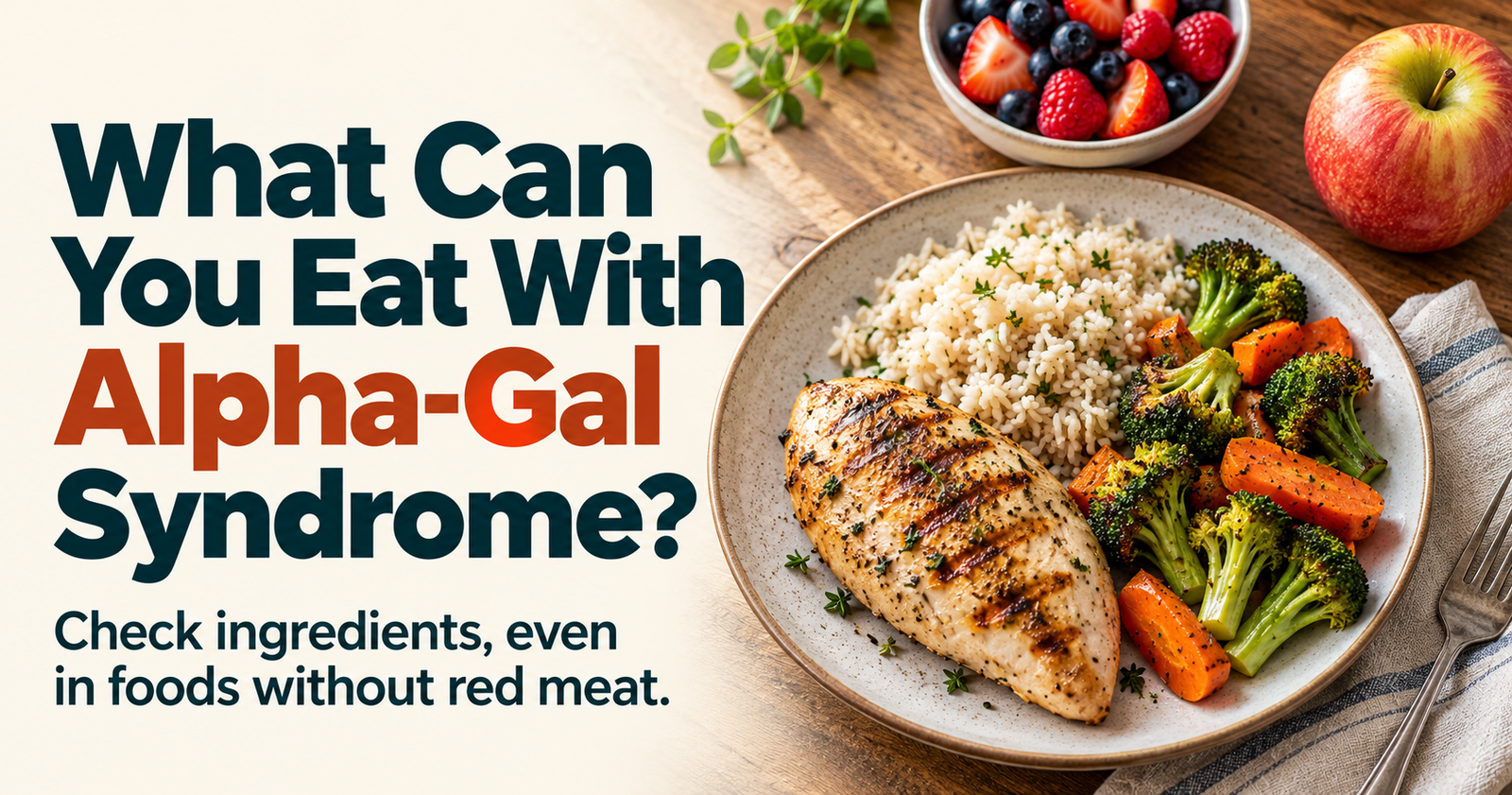
If you’re still figuring out the bigger food picture, our guide to what you can eat with Alpha-gal syndrome explains the major food categories without getting lost in every individual label.
Why I’d Look at the Ingredients on the Back, Not Just the Product Description
A product’s marketing name isn’t an ingredient guarantee.
Turkey sausage sounds straightforward.
But I’d still read the package to see whether it contains pork casing, mammalian fat, or other ingredients that matter for my avoidance plan.
Chicken broth sounds straightforward too.
I’d still check the ingredient list rather than assuming every product labeled chicken broth has exactly the same formulation.
Vegetarian is another useful description, but it doesn’t necessarily mean dairy-free.
A vegetarian frozen meal might contain cheese, butter, or cream.
That may be perfectly acceptable for someone with AGS who tolerates dairy.
It may not work for someone whose allergist has recommended avoiding dairy.
The label needs to match the individual.
Not just the category.

How I’d Handle Milk Ingredients on a Food Label
Milk is one of the easier mammalian ingredients to identify on many U.S. packaged foods because it’s a major food allergen.
You may see ingredients such as:
Milk
Cream
Butter
Whey
Casein
Milk powder
Nonfat dry milk
Those ingredients can tell you that dairy is present.
But the next question is whether dairy is something your individual Alpha-gal management plan requires you to avoid.
Many people with AGS tolerate milk products, while others need additional restrictions.
That’s why I wouldn’t automatically treat every package containing milk as forbidden for everyone with Alpha-gal.
We covered that distinction in our separate guide to whether you can eat dairy with Alpha-gal syndrome.
For grocery shopping, the practical habit is simple.
Identify the dairy first. Then apply your personal avoidance plan.
Gelatin Is Where the Label Can Leave You Guessing
Gelatin is a good example of an ingredient that may be clearly listed but still leave an important question unanswered.
You pick up gummy candy.
The ingredient list says:
Gelatin
Okay.
But gelatin from what?
Pork?
Beef?
Fish?
The package may not say.
And if mammalian gelatin is something you need to avoid, that missing information matters.
What I’d do instead of guessing
I’d check whether the manufacturer identifies the gelatin source.
If not, I’d contact the company.
I’d ask:
“Is the gelatin in this product derived from pork, beef, fish, or another source?”
That’s specific enough that customer service may be able to investigate.
And if the company can’t answer, I’d look for an alternative with a clearer ingredient source.
Our separate article on gelatin and Alpha-gal syndrome covers gummies, marshmallows, gelatin capsules, and alternatives in much more detail.
What Does “Natural Flavors” Mean for Alpha-Gal?
This is where I’d be careful not to let label reading turn into panic.
Natural flavors can come from different sources, including plants and animals.
But the words natural flavors don’t automatically mean beef, pork, or another mammalian ingredient is present.
And they don’t automatically guarantee the opposite either.
The phrase describes a broad ingredient category.
When would I investigate further?
If I had a history of reacting to a particular product, I’d want to know more.
If my allergist had advised me to avoid certain mammalian derivatives beyond the obvious foods, I’d ask whether a vague ingredient could involve those sources.
If the product otherwise contained no ingredients of concern and my individual avoidance plan didn’t require investigating every possible source of natural flavoring, I wouldn’t automatically assume it was unsafe.
An ingredient being theoretically animal-derived isn’t the same as proving that it contains clinically relevant alpha-gal.
That distinction can save a lot of unnecessary worry.
What About Mono- and Diglycerides?
These ingredients show up in a variety of packaged foods.
They’re commonly used as emulsifiers, helping ingredients such as fats and water mix more consistently.
Depending on the manufacturing process, their fatty-acid components may originate from plant or animal sources.
The ingredient name alone may not reveal that source.
But here’s where I’d avoid making an unsupported leap.
Animal-derived does not automatically establish that a particular processed ingredient contains enough alpha-gal to trigger a reaction.
The source, processing, formulation, and individual sensitivity can matter.
I wouldn’t put every food containing mono- and diglycerides on a universal forbidden list.
If the source is important to your personal medical guidance, that’s when contacting the manufacturer becomes useful.
Does Glycerin Mean a Food Contains Alpha-Gal?
Not necessarily.
Glycerin, also called glycerol, can be produced from plant-derived or animal-derived materials, among other sources.
But seeing glycerin on an ingredient label does not prove that the finished product contains alpha-gal.
This is an area where online Alpha-gal lists can become confusing because they sometimes treat every ingredient that could originate from a mammal as though it definitely contains alpha-gal.
That’s not a reliable way to evaluate food.
If a particular product or ingredient concerns you, your allergist or another qualified healthcare professional can help determine whether the concern is relevant to your sensitivity.
I would rather investigate a specific product than eliminate an entire ingredient category based on an assumption.
How I’d Check a Food Label in Under 30 Seconds
I don’t want to stand in the grocery aisle researching every ingredient while the frozen food in my cart melts.
So I’d use a three-pass system.
Pass 1: Look for the obvious mammalian ingredients
This should take seconds.

I’d scan for things such as beef, pork, lamb, gelatin, lard, tallow, suet, meat stock, meat broth, and other clearly identified mammalian ingredients. The pork-specific guide can help put pork, lard, and other mammalian ingredients into the context of everyday foods and cooking ingredients.
If dairy is something I personally need to avoid, I’d check for that too.
Sometimes the decision ends right there.
A soup contains beef stock.
I put it back.
I don’t need to investigate the remaining 24 ingredients.
Pass 2: Check ingredients that need context
If nothing obvious jumps out, I’d look at ingredients whose source might matter for my particular sensitivity.
This is where gelatin, certain fats, vague flavorings, or other ingredients may deserve another look.
But I wouldn’t research every ingredient that could theoretically come from an animal.
I’d focus on ingredients my allergist has told me matter and anything connected with my previous reactions.
Pass 3: Decide whether this product is worth investigating
This sounds minor, but it saves a lot of time.
If I’m looking at one brand of crackers with a confusing label and another brand beside it has a simple ingredient list I understand, I may just buy the simple one.
Not every mystery needs solving.
Sometimes the easiest Alpha-gal shopping trick is simply:
Buy the product that gives you a clearer answer.
I Keep a Mental “Definitely Check This” List
I find this much easier than carrying around an enormous list of every ingredient that has ever possibly been made from a mammal.
My high-priority list would include obvious mammalian meats and ingredients directly derived from them.
I’d pay particular attention to:
Beef, pork, lamb, venison and other mammalian meats
Beef or meat broth and stock
Gelatin
Lard
Tallow
Suet
Animal fat when the animal isn’t identified
Dairy, if dairy is part of my individual avoidance plan
Then I deal with ambiguous ingredients according to my actual sensitivity rather than automatically treating every unknown word as dangerous.
That difference matters.
“Animal Fat” Is a Label I’d Want More Information About
If a product simply says animal fat, that’s not very helpful when the animal source matters.
Animal fat could potentially be mammalian.
I’d want to know more.
If the manufacturer clearly identifies chicken fat, that’s a different question because chickens aren’t mammals.
If it says beef fat or tallow, the mammalian source is obvious.
If it only says animal fat and my avoidance plan requires me to avoid mammalian fats, I wouldn’t guess.
I’d either investigate the source or pick another product.
Broth Is One of the Easiest Ingredients to Miss
Broth deserves special attention because it appears in foods where meat isn’t necessarily the star of the show.
Rice mixes.
Soups.
Gravy.
Stuffing.
Frozen meals.
Sauces.
Seasoned vegetables.
Beans.
A product may have chicken pictured on the front but still contain another type of broth or flavoring.
That’s why I look at the actual ingredient list.
I’d pay attention to the exact wording
Vegetable broth is different from beef broth.
Chicken broth is different from beef stock.
And a vague meat broth deserves another look if the animal isn’t identified.
This is also why I’d never assume a restaurant soup is safe just because there aren’t visible pieces of beef or pork floating in it.
The broth can matter.
Bacon Can Hide in Foods That Don’t Look Like Bacon
This is one of those everyday examples that makes Alpha-gal shopping and eating different.
Green beans can contain bacon.
Baked beans can contain pork.
Potato dishes can be made with bacon grease.
Greens may be seasoned with ham hock.
A soup may use pork for flavor without looking like a pork dish.
So I don’t judge a prepared food only by its main ingredient.
I ask:
What was this cooked with?
That question becomes particularly important once you move from packaged groceries into restaurant and homemade food.
I’d Treat “Pork-Free” and “Beef-Free” as Partial Information
A package saying pork-free answers the pork question.
It doesn’t necessarily answer the beef question.
Likewise, something marketed as beef-free could still contain pork-derived ingredients.
This is why broad front-label claims rarely replace reading the ingredients.
The same goes for:
Meat-free
Vegetarian
Dairy-free
Gelatin-free
Each claim answers a particular question.
None automatically means:
Suitable for every person with Alpha-gal syndrome.
I want to know what the product actually contains.
Vegan Labels Can Be Extremely Useful, but I Still Read the Package
A vegan product should not intentionally contain animal-derived ingredients.
That can make vegan products useful when I’m looking for alternatives to gelatin, dairy, lard, tallow, or other mammalian ingredients.
But I wouldn’t turn the vegan logo into a reason to stop reading labels entirely.
People can have other allergies.
Formulations can change.
And “plant-based” marketing isn’t necessarily identical to a certified or clearly labeled vegan formulation.
Still, if I’m looking for marshmallows without mammalian gelatin or a dairy-free alternative, vegan is one of the most useful search terms I can use.
It narrows the field quickly.
Vegetarian Doesn’t Mean Mammal-Free
This one is easy to mix up.
Vegetarian foods can contain dairy.
They may contain cheese.
Milk.
Butter.
Cream.
Depending on the definition and product, other animal-derived ingredients may be present too.
For someone with AGS who tolerates dairy, that may not be an issue.
For somebody who doesn’t, vegetarian labeling doesn’t answer enough.
This is another reason personal tolerance matters so much.
Two people with Alpha-gal can pick up the exact same vegetarian frozen meal and make different decisions based on their individual medical guidance.
“Plant-Based” Is a Clue, Not My Final Answer
Plant-based has become a huge marketing phrase.
Plant-based burgers.
Plant-based frozen meals.
Plant-based snacks.
I’d consider that encouraging when I’m looking for alternatives, but I’d still turn the package around.
There isn’t one universal meaning printed into every use of the phrase.
If avoiding mammalian ingredients matters medically, I want the ingredient list to confirm what the advertising is suggesting.
Front of package:
Plant Based!
Back of package:
That’s where I make the decision.
I Would Save Photos of Labels That Work for Me
This is one of the simplest habits I’d use.
When I find a packaged product that works well for my individual needs, I’d take pictures.
Front of package.
Ingredient list.
Brand and exact variety.
Then I’d put those pictures into an album on my phone called something obvious like:
Foods I Buy
That way, if I’m at a different grocery store and can’t remember which version I bought, I have the package in my pocket.
This can also help when someone else is shopping for you.
Instead of texting:
“Get the crackers I can eat.”
Send the picture.
Much easier.
But I Would Still Recheck the Label When I Buy It Again
This is the annoying part.
Manufacturers change recipes.
A product you’ve bought ten times can be reformulated.
The package design may barely change.
An ingredient can be added.
A supplier can change.
That’s why I don’t want to treat an old photograph, an old blog post, or somebody’s three-year-old Facebook comment as more authoritative than the package currently sitting in my hand.
My rule would be simple
If I haven’t bought something in a while, I check it again.
If the packaging looks different, I check it again.
If the product suddenly tastes or looks different, I check it again.
If the company announces a reformulation, I definitely check it again.
It takes seconds once you’re used to doing it.
What If the Manufacturer’s Website and Package Disagree?
I’d trust the current physical package I’m actually buying as an important source of information, while recognizing that a serious discrepancy deserves clarification.
Websites can lag behind formulation changes.
Retailer listings can be even worse.
A grocery-store website may show an old photograph of the ingredients.
An online marketplace listing may combine reviews and photographs from several versions of a product.
That’s why I’d be cautious about deciding whether a food works for me based solely on an online product photo.
If something doesn’t add up, I’d contact the manufacturer.
What I’d Ask a Food Company
I wouldn’t send a company a three-paragraph explanation of Alpha-gal syndrome unless necessary.
I’d ask a question they can actually answer.
For gelatin:
“Is the gelatin in this product derived from beef, pork, fish, or another source?”
For animal fat:
“What animal source is used for the animal fat listed in this product?”
For a flavoring:
“Does the natural flavor in this product contain ingredients derived from beef, pork, lamb, or another mammal?”
For a product where the formula is unclear:
“Can you confirm whether this specific product contains ingredients derived from non-primate mammals?”
Specific questions give customer-service teams something concrete to investigate.
I’d Save Manufacturer Answers Too
If I take the time to email or call a company, I’m not doing that work twice if I can help it.
I’d save the response.
Screenshot it.
Put it in the same food album or notes folder.
Include the product name and date.
That last part matters because formulations and suppliers can change.
An answer from 2026 tells me what the company said in 2026.
It isn’t a lifetime guarantee.
But it’s much better than relying on my memory.
Barcode Apps Can Help, but I Wouldn’t Let an App Make the Decision for Me
There are apps that scan barcodes and flag ingredients according to dietary preferences or allergies.
Those can be convenient.
But I wouldn’t treat an app as my final authority for Alpha-gal.
Apps rely on databases.
Databases can be outdated.
Ingredient sourcing can be complicated.
And individual Alpha-gal sensitivity varies.
I’d use an app to save time or flag something worth investigating.
Then I’d verify important information on the current package or with the manufacturer.
Convenience tool, yes. Medical authority, no.
Online Grocery Shopping Needs the Same Caution
Ordering groceries online can actually make label reading easier in some ways.
You can sit at home and research products instead of standing in an aisle.
But there’s a catch.
Ingredient information on retailer websites isn’t always current.
I’d look for the manufacturer’s own current product information when possible.
And when the groceries arrive, I’d still compare the actual package with what I expected.
If the store substitutes another brand, I check the substitute.
That’s especially important because a substitution may look nearly identical while using a different formulation.
Store Brands Can Be Completely Different From Name Brands
I wouldn’t assume the generic version of a product has the same ingredients as the brand-name version.
Sometimes they’re similar.
Sometimes they aren’t.
The same goes in reverse.
Maybe the store brand has the simpler ingredient list.
That’s why Alpha-gal shopping can occasionally save money rather than cost more.
I don’t care which logo is on the front.
I care what the back says.
Family-Size and Regular Packages Can Even Deserve a Check
This is a habit I’d build simply because food manufacturing can be weird.
Different package sizes, flavors, seasonal editions, or varieties aren’t guaranteed to have identical formulas.
“Original” and “Extra Creamy” definitely aren’t the same product.
Neither are regular and sugar-free versions.
So when someone tells me:
“That brand is safe,”
I want to know:
Which exact product?
Brand names don’t have Alpha-gal.
Ingredients do.
This Is Why I Don’t Like Universal “Safe Brand” Lists
A list saying:
Brand X is Alpha-gal safe
sounds convenient.
But it’s too broad for me.
A company can make hundreds of products.
One might contain gelatin.
Another doesn’t.
One contains dairy.
Another is vegan.
One gets reformulated next year.
I’d much rather identify specific products that fit my individual needs.
That approach takes a little more work initially, but it’s much harder for a broad assumption to trip me up later.
I’d Make My Own Grocery List Over Time
After a while, I don’t want to research cereal every week.
I want:
My cereal.
My bread.
My crackers.
My marshmallows.
My gummy candy.
My soup.
My frozen meal.
Whatever products work for my needs become the default.
Then grocery shopping starts feeling normal again.
I’m not performing an Alpha-gal investigation every time I need lunch.
I’m buying groceries.
That’s the point I want to get to.
I’d Keep New Foods Separate From My Regular Foods Mentally
If I try something new, I pay more attention.
I keep the package.
I know what I ate.
I know roughly when I ate it.
That isn’t because I expect a reaction.
It’s because if something strange does happen hours later, I don’t want to be digging through the trash trying to remember what was in dinner.

Alpha-gal food reactions can be delayed, which makes keeping track of unfamiliar products particularly useful. Understanding recognizing the first signs of Alpha-gal can make it easier to connect a delayed reaction with something eaten earlier.
Our guide to how long after eating an Alpha-gal reaction can start explains why that timing can make identifying a food trigger surprisingly difficult.
I Wouldn’t Blame Every Symptom on the Last Packaged Food I Ate
This matters too.
Once you’re diagnosed with an allergy, it’s easy to make the allergy responsible for everything.
Stomach hurts?
Must have been Alpha-gal.
Itching?
Must have been something in lunch.
Headache?
Maybe there was a hidden mammalian ingredient.
That’s not a great way to live, and it isn’t necessarily medically accurate.
If I have a suspected reaction, I’d document it.
If a pattern develops, I’d discuss it with my healthcare provider.
I wouldn’t add five more ingredients to my personal forbidden list every time I feel bad.
Patterns are more useful than panic.
When I’d Stop Reading Labels and Call My Allergist
Food labels can answer ingredient questions.
They can’t answer every medical question.
If I find myself eliminating more and more foods because I’m reacting frequently or can’t figure out what’s triggering symptoms, that’s when I’d want professional help.
I’d bring:
- My food notes
- Photos of labels
- Reaction times
- Symptoms
- Products I suspect
- My questions about ambiguous ingredients
That’s much more useful than walking into the appointment saying:
“I think everything is bothering me.”

If you haven’t gone through the diagnostic side yet, our guide to how Alpha-gal syndrome is diagnosed explains why symptoms, timing, testing, and clinical history all belong together.
My Grocery Cart Doesn’t Need to Look Like Somebody Else’s
This is the part I keep coming back to.
Alpha-gal syndrome varies.
Some people tolerate dairy.
Some don’t.
Some people react to mammalian gelatin.
Others may tolerate products containing it.
Some people have a more restrictive medical plan than others.
So I don’t want a stranger’s grocery cart.
I want my grocery cart, built around my medical guidance, my tolerance history, and foods I actually enjoy eating.
That’s why reading labels is so much more valuable than memorizing a giant list.
A list tells you what somebody else avoids.
A label helps you make a decision about the food sitting in your hand.
The Three Questions I’d Keep Coming Back To
When a package starts getting confusing, I’d simplify it.
What is definitely in this product?
Read the ingredients.
Start with facts.
Which of those ingredients actually matter for my Alpha-gal plan?
Not every mammal-derived possibility matters equally to every person.
What information am I missing?
If the gelatin source is unknown or an ingredient source genuinely matters, investigate that specific question.
That’s it.
I don’t need to solve the entire food-manufacturing industry before putting crackers in my cart.
Label Reading Should Eventually Get Boring
That’s actually my goal.
At first, everything feels important.
You read every line.
Google ingredients in the aisle.
Take screenshots.
Compare five brands.
Wonder whether something you’ve eaten for years suddenly needs investigating.
But eventually patterns emerge.
You know the obvious mammalian ingredients.
You know which dairy products fit your individual plan.
You know what gelatin means for you.
You know your regular brands.
You know which vague ingredients your allergist actually wants you to investigate.
And grocery shopping gets faster.
That’s where I want to end up.
Not fearless because I stopped paying attention.
Confident because I know what deserves my attention and what doesn’t.
There are plenty of complicated parts of living with Alpha-gal syndrome. Buying a box of cereal doesn’t need to remain one of them forever.
As we keep building the Food, Labels and Shopping section, I’ll keep breaking individual ingredients and grocery decisions down this same way: what we actually know, what depends on the person, and what I’d check before putting the product in my cart.
Hannah Brooks writes about the everyday reality of managing food with Alpha-gal syndrome for After The Tick, from decoding ingredient labels and finding workable substitutes to making grocery shopping feel normal again.