

Alpha-gal syndrome doesn’t always announce itself with one obvious reaction that makes the cause immediately clear. For some people, the first clue is hives after a meal. For others, it’s repeated stomach pain, diarrhea, nausea, swelling, or a strange pattern of waking up sick several hours after dinner.
That delay is one of the biggest clues. Alpha-gal reactions commonly begin 2 to 6 hours after exposure, particularly after eating mammalian meat or another product containing alpha-gal. That means the food responsible may be long forgotten by the time symptoms begin.
The first signs can also vary tremendously from one person to another. Some people have mostly digestive trouble. Some develop skin symptoms. Others can experience a serious allergic reaction involving breathing, blood pressure, or multiple parts of the body.
So if you’re trying to figure out whether Alpha-gal could explain something happening to you, don’t look for one single “classic” first symptom. Look for a pattern, especially delayed symptoms after mammalian foods combined with a history of possible tick exposure.

The First Signs of Alpha-Gal Can Be Surprisingly Easy to Miss
When most people picture a food allergy, they imagine someone taking a bite of food and immediately developing hives or having trouble breathing.
Alpha-gal syndrome can behave differently.
A person might eat a hamburger at 6 p.m., feel perfectly fine through dinner, watch television, go to bed, and then develop itching, stomach cramps, diarrhea, swelling, or another reaction hours later.
It’s easy to see how the connection gets missed.
If your stomach starts hurting at midnight, you’re probably not automatically thinking about the cheeseburger you ate six hours earlier. You might blame a stomach bug, indigestion, something you ate right before bed, or just bad luck.
Then it happens again two weeks later.

Maybe the meals aren’t even the same. One night was a burger. Another was pork. Another was venison. If pork is part of that pattern, what pork foods to examine can help identify both obvious foods and less visible ingredients to review.
That’s when the pattern starts becoming more important than any single meal.
If this is the first time you’ve encountered the condition, our guide explaining what Alpha-gal syndrome actually is will help make sense of why foods that never bothered you before can suddenly become a problem.
Common Early Signs of Alpha-Gal Syndrome
There isn’t a required first symptom that everyone experiences.
Alpha-gal reactions can involve the skin, digestive system, respiratory system, cardiovascular system, or several of these at once.
Some of the symptoms associated with AGS include:
- Hives or an itchy rash
- Stomach pain or cramping
- Diarrhea
- Nausea or vomiting
- Heartburn or indigestion
- Swelling of the lips, tongue, throat, or eyelids
- Coughing or shortness of breath
- Dizziness or feeling faint
- A drop in blood pressure
- Anaphylaxis
What makes this list tricky is that many of these symptoms are incredibly common on their own.
One upset stomach doesn’t point directly to Alpha-gal.
Neither does one random rash.
What deserves more attention is a repeating pattern, particularly when symptoms happen several hours after eating mammalian meat or another potential source of alpha-gal.

Stomach Problems May Be One of the First Clues
This is a part of Alpha-gal that I think deserves much more attention.
You do not necessarily have to break out in hives for AGS to affect you.
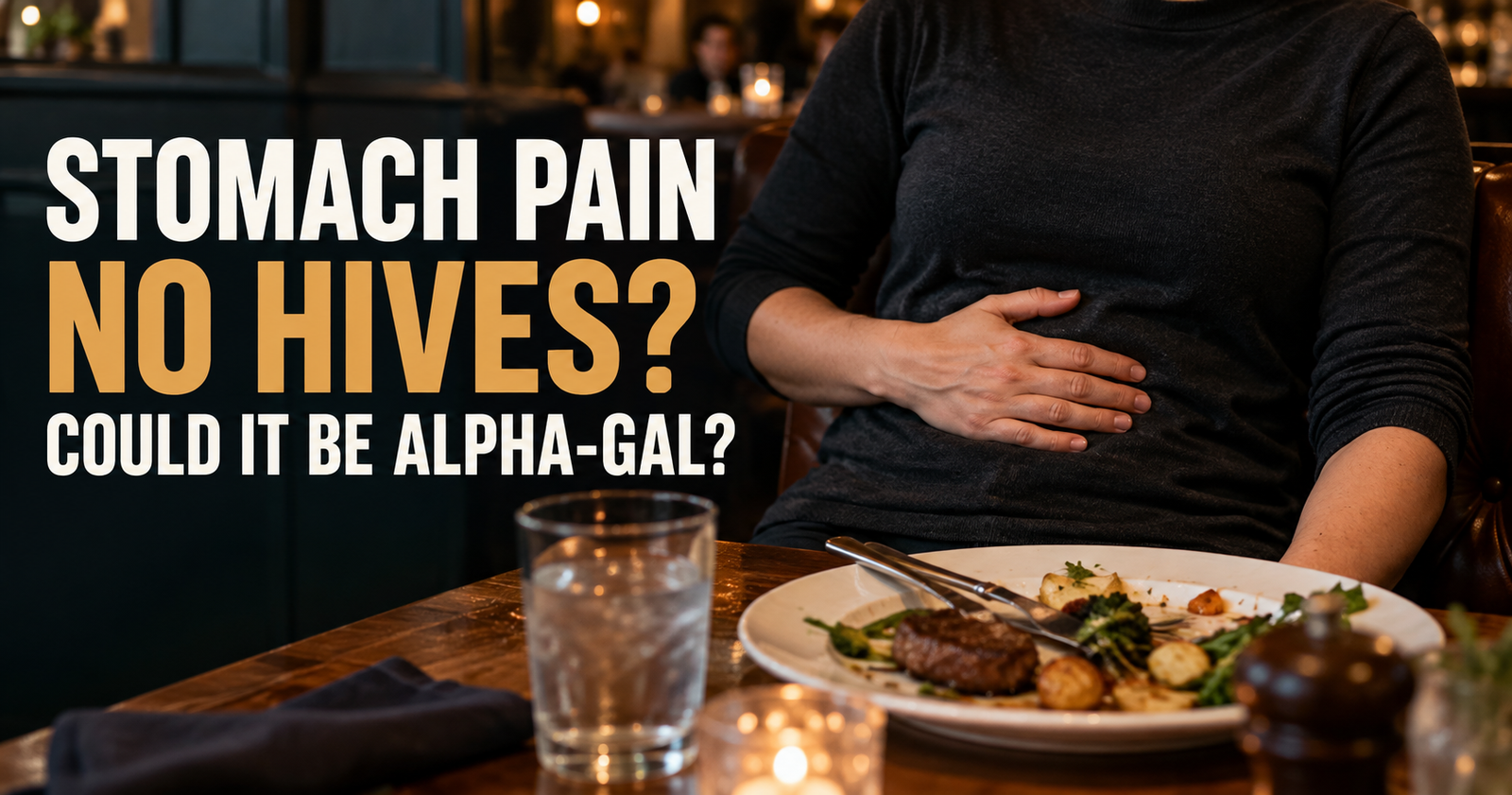
Some people experience primarily gastrointestinal symptoms such as abdominal pain, cramping, nausea, vomiting, or diarrhea. Research has documented people with Alpha-gal who have gastrointestinal symptoms without accompanying skin, breathing, or circulatory symptoms.
That can make AGS especially difficult to recognize.
Imagine having severe stomach cramps and diarrhea several hours after dinner but no rash, no swollen lips, and no trouble breathing.
A food allergy may not even cross your mind.
You might start wondering about lactose intolerance, irritable bowel syndrome, food poisoning, greasy food, gallbladder trouble, or any number of other digestive problems.
Those possibilities can certainly cause similar symptoms too, which is exactly why symptoms alone shouldn’t be used to diagnose yourself.
But recurring delayed digestive problems after mammalian foods are worth mentioning to a healthcare professional, especially if you’ve also had tick exposure. Because pork can also cause digestive discomfort for reasons unrelated to Alpha-gal, stomach pain after eating pork may help you compare possible explanations before speaking with a healthcare professional.
We’re going to cover stomach-only Alpha-gal reactions in their own article because there’s enough confusion around them that they deserve much more than a couple of paragraphs here.
Hives and Itching Can Be an Early Warning
Skin symptoms are another common presentation.
You may notice raised, itchy welts or widespread itching after eating.
Sometimes the connection to food seems obvious. Other times it doesn’t because several hours have passed.
Hives can also come and go quickly, which makes the situation even more confusing.
Someone may wake up itching in the middle of the night, notice hives across the stomach or arms, take care of the immediate problem, and wake up the next morning wondering what caused it.
If it only happens once, determining the trigger can be difficult.
If it keeps happening after meals containing beef, pork, venison, lamb, or other mammalian products, that’s a pattern worth writing down and discussing with a doctor or allergist.


Swelling Can Happen Too
Alpha-gal reactions can cause swelling, also called angioedema.
This may involve areas such as the lips, eyelids, tongue, or throat.
Mild-looking swelling shouldn’t be used as a reason to assume the next reaction will also be mild. Allergic reactions aren’t always predictable from one episode to the next.
Swelling involving the tongue or throat is particularly concerning because it can interfere with breathing.
If you’re experiencing throat swelling, difficulty breathing, fainting, severe dizziness, or a rapidly worsening allergic reaction, seek emergency medical care immediately.
This isn’t the time to sit at home trying to decide whether Alpha-gal is responsible.
The Delay Is One of the Biggest Clues
This is where AGS really stands apart from many familiar food allergies.
Symptoms after eating mammalian meat often don’t begin immediately.
The CDC currently describes reactions as typically appearing 2 to 6 hours after exposure.
That delay can create some strange situations.
Dinner might be the trigger, but the reaction happens after you’ve gone to sleep.
Lunch might be the trigger, but you don’t feel sick until late afternoon.
You might eat beef and feel fine long enough that you assume beef couldn’t possibly have caused the problem.
That makes keeping track of what you ate several hours before a reaction much more useful than only thinking about what you consumed immediately before symptoms started.
The timing isn’t identical for everyone or every exposure, either. Individual reactions can vary.
We’re going to dig much deeper into this in the next article dedicated specifically to how long after eating an Alpha-gal reaction can start, because timing is important enough to deserve its own guide.
The First Reaction Doesn’t Necessarily Happen Right After the Tick Bite
Here’s another timing issue that’s easy to confuse.
A tick can bite you without you developing symptoms the next day.
According to current CDC information, it can take weeks to months after a tick bite before a person begins experiencing symptoms of Alpha-gal syndrome.
That makes tracing everything back to a specific bite difficult.
You may not remember the tick.
You may have removed one months earlier and completely forgotten about it.
You may never have noticed the bite at all.
That’s particularly possible with very small ticks or bites in hard-to-see places.

The connection makes more sense once you understand how a tick bite can lead to Alpha-gal sensitization. The bite can change the immune response first, with reactions to alpha-gal appearing later.
Can Alpha-Gal Start With Just Heartburn or Indigestion?
It can cause heartburn or indigestion, but those symptoms by themselves are far too common to point directly to AGS.
This is where I would be careful about reading symptom lists online and matching yourself to every item.
Heartburn can have many causes.
So can bloating, nausea, stomach pain, and diarrhea.
Instead of asking, “Have I ever had heartburn?” look at the larger pattern.
Did symptoms begin after a period of tick exposure?
Do they repeatedly happen after certain mammalian foods?
Do they appear several hours after eating?
Are there additional symptoms such as itching, hives, swelling, or diarrhea?
The pattern gives a healthcare professional much more useful information than one isolated symptom.
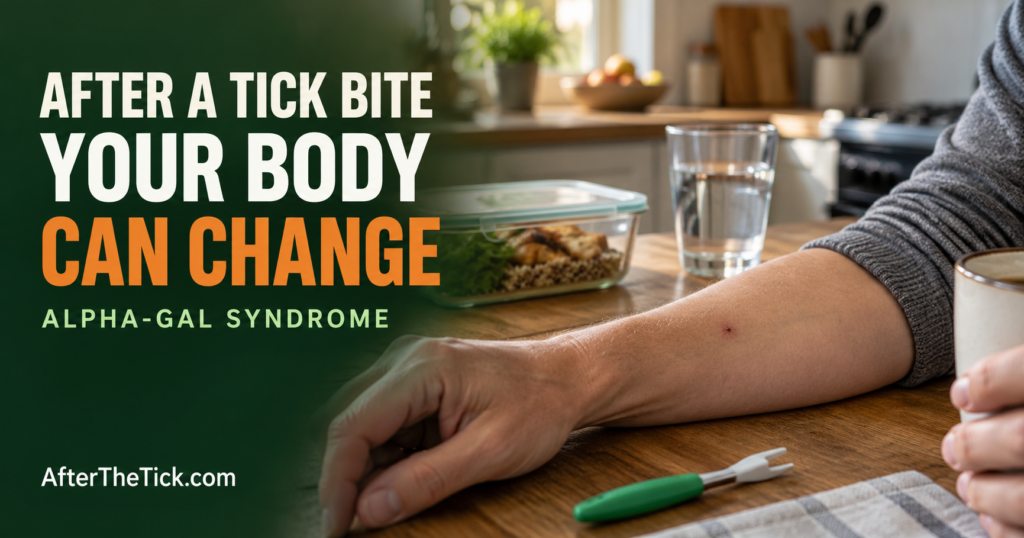

Can Alpha-Gal Start With Diarrhea and No Hives?
Yes, gastrointestinal-only Alpha-gal reactions have been documented.
That’s important enough to repeat because it’s one of the easiest presentations to overlook.
Someone can have abdominal pain, nausea, vomiting, or diarrhea without the obvious skin symptoms we normally associate with an allergy.
Recent research continues to show how prominent gastrointestinal symptoms can be in AGS. A 2026 systematic review and meta-analysis involving more than 1,100 patients found that gastrointestinal symptoms were common among people with the syndrome.
That doesn’t mean unexplained diarrhea equals Alpha-gal.
Far from it.
But if you repeatedly develop digestive symptoms hours after eating mammalian foods, particularly after tick exposure, I wouldn’t dismiss the pattern simply because you never developed hives.
Can Your First Alpha-Gal Reaction Be Severe?
Yes.
Alpha-gal reactions range from relatively mild symptoms to potentially life-threatening anaphylaxis.
Unfortunately, you can’t reliably use a previous mild reaction to guarantee that a future reaction will also be mild.
That’s one reason I wouldn’t recommend deliberately eating a food you suspect has caused an allergic reaction just to see whether it happens again.
There are safer ways for a healthcare professional to investigate suspected AGS.
If a reaction involves difficulty breathing, throat or tongue swelling, fainting, severe dizziness, a significant drop in blood pressure, or rapidly worsening symptoms, get emergency medical help.
Why Did I Eat the Same Food Before Without a Reaction?
This question can make people doubt what they’re experiencing.
Maybe you ate pork on Tuesday and nothing happened.
Then you ate pork again Saturday and became sick.
Doesn’t that prove pork wasn’t responsible?
Not necessarily.
Alpha-gal reactions aren’t perfectly consistent. The CDC notes that a person may not react to every product containing alpha-gal and that the symptoms or severity can differ between exposures.
Individual sensitivity matters.
The amount and type of alpha-gal exposure may matter too, and researchers have studied other factors that can influence reactions.
The important point is that one meal without symptoms doesn’t automatically rule out AGS.
This is another reason tracking several episodes can be much more revealing than analyzing one dinner in isolation.
What Foods Usually Make the Pattern More Noticeable?
Mammalian meat is the obvious place people start looking.
That includes foods such as beef, pork, lamb, venison, and other meats from mammals.
But Alpha-gal isn’t literally an allergy to the color red.
It’s an immune reaction involving the alpha-gal molecule.
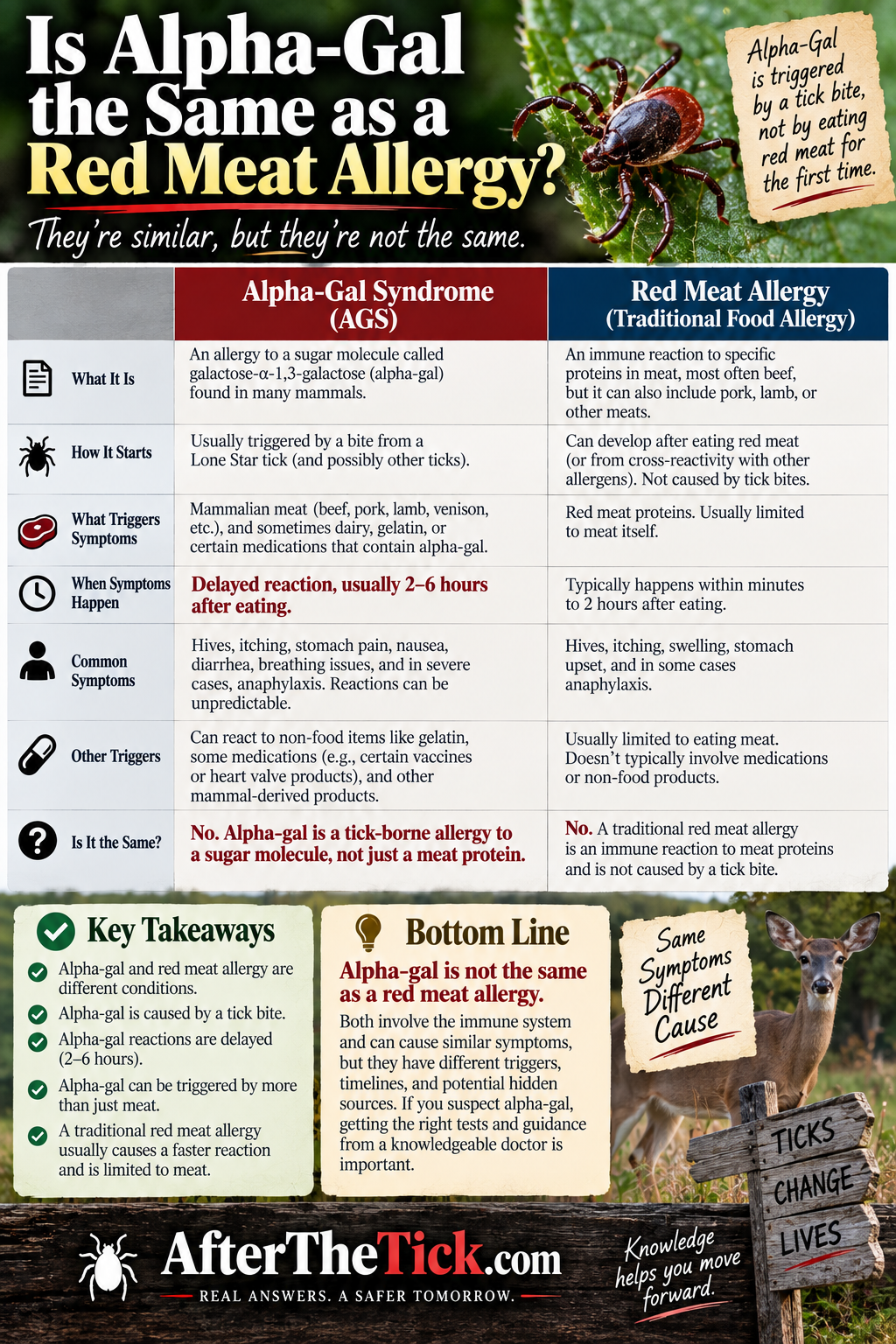
That distinction becomes important because mammal-derived ingredients can turn up in foods and products that don’t look anything like a steak. The difference between Alpha-gal syndrome and a conventional red meat allergy is explained in mammal-derived ingredients.
Dairy is tolerated by some people with AGS and not by others. Gelatin and other mammal-derived ingredients can also matter for some people. The practical question is often how to evaluate a potential gelatin exposure in Alpha-gal syndrome when symptoms or food triggers are unclear.
For someone just trying to figure out their first symptoms, though, I wouldn’t start by becoming terrified of every ingredient in the kitchen.
Start by documenting what actually happened.
Then work through possible exposures systematically with appropriate medical guidance.
What About Chicken, Turkey, and Fish?
Chicken and turkey are birds, not mammals. Fish and shellfish aren’t mammals either.
They don’t naturally contain alpha-gal in the same way mammalian meat does.
That distinction becomes very useful once someone starts learning how Alpha-gal affects food choices.
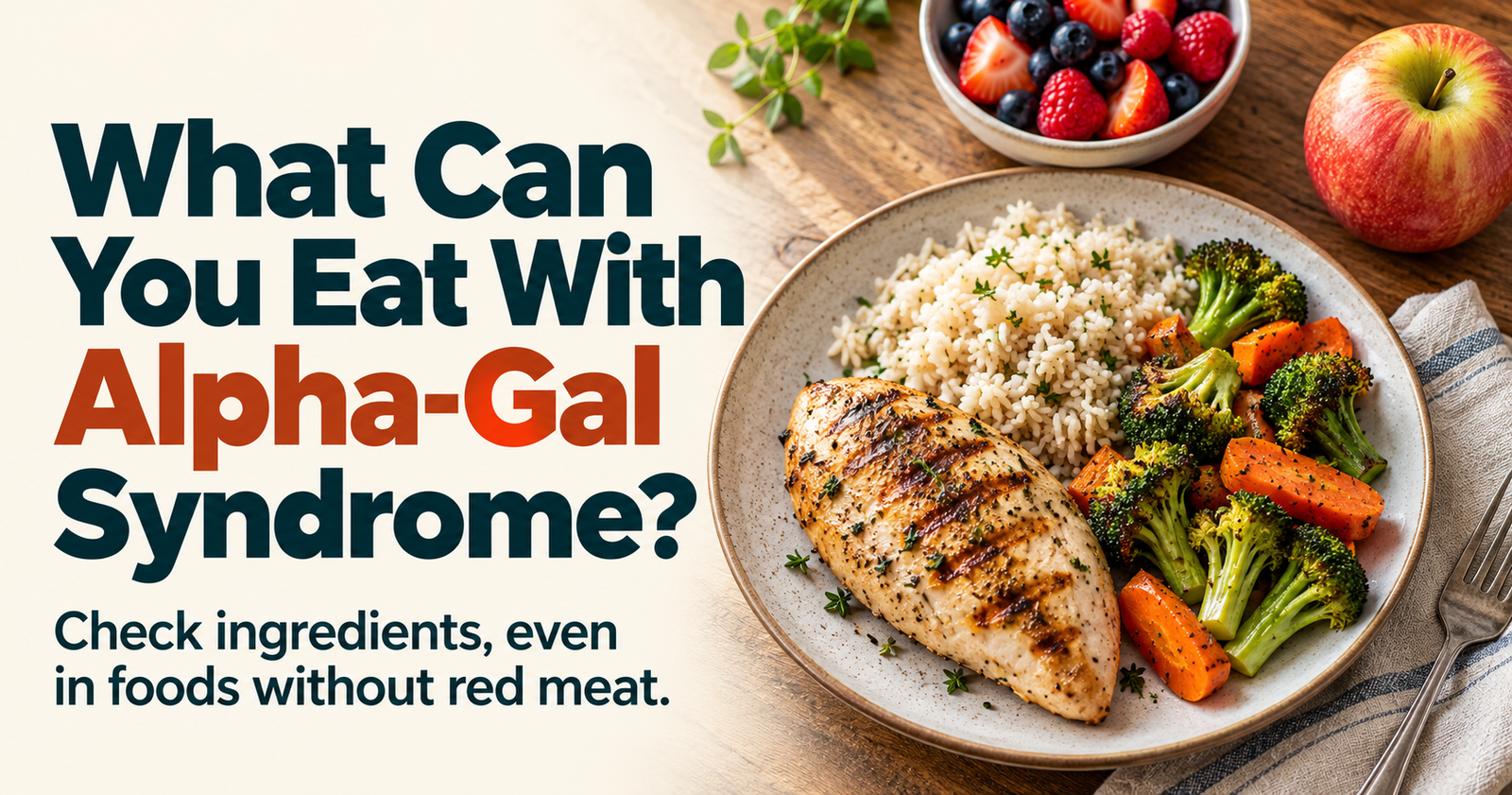
However, prepared foods can become more complicated because sauces, broths, fats, seasonings, cooking surfaces, or other ingredients may introduce mammal-derived components. That is why choosing foods and checking ingredients matters when building meals around Alpha-gal concerns.
That’s why a simple question like “Is chicken okay?” can eventually turn into “How was this particular chicken prepared?”
We’ll get much deeper into those real-world food questions once we move into the Food, Labels and Shopping cluster. For now, the important thing is understanding what kinds of exposures may help reveal a symptom pattern.
Don’t Ignore the Time of Day
If you’re trying to make sense of unexplained symptoms, the clock can tell you a surprising amount.
Suppose you repeatedly wake up around 1 or 2 a.m. with stomach pain, diarrhea, itching, or hives.
Instead of only asking what happened at bedtime, think backward.
What did dinner look like?
Did you eat a burger at 7 p.m.?
Pork chops?
Venison chili?
Something containing mammalian ingredients?
A reaction several hours after an evening meal can easily disguise the food connection.
I wouldn’t use timing alone to diagnose AGS, but delayed symptoms are an important clue doctors consider when evaluating it.
What Should You Write Down If You Suspect Alpha-Gal?
You don’t need a complicated spreadsheet or an app.
A basic note on your phone can be surprisingly useful.
For each unexplained episode, record:
- What you ate and drank
- Approximately what time you ate
- When symptoms started
- Exactly what symptoms occurred
- How long they lasted
- Any medications or supplements you had taken
- Whether you had exercised or consumed alcohol around that time
- Any recent tick bites or significant outdoor exposure
Don’t wait several days and try to reconstruct everything from memory.
When something strange happens, write it down while dinner and the timing are still fresh in your mind.
After several episodes, you may notice a pattern that wasn’t obvious at all from the first reaction.
That information can also be much more useful when you sit down with your doctor or allergist.
Should You Stop Eating Mammalian Meat If You Think You Have Alpha-Gal?
This is where individualized medical advice matters.
I wouldn’t tell someone to diagnose themselves from an internet article, radically change their diet, or intentionally eat a suspected trigger to test the theory.
If you’re repeatedly experiencing symptoms that make you suspect AGS, talk with a healthcare professional or allergist.

Diagnosis generally involves your medical history, symptoms, possible tick exposure, and testing for alpha-gal-specific IgE antibodies. The diagnosis process is explained in more detail in Alpha-gal syndrome diagnosis.
Even the blood test isn’t meant to stand completely on its own. People can have detectable alpha-gal IgE without necessarily having clinical Alpha-gal syndrome. Readers who receive that result can use this explanation of a positive Alpha-gal blood test to understand why symptoms and history still matter.
That’s why the story behind the test matters.
A Tick Bite Plus Stomach Trouble Doesn’t Automatically Mean Alpha-Gal
This deserves saying plainly.
Tick bites are common.
Stomach problems are common.
Rashes are common.
Heartburn is common.
Putting two common things together doesn’t automatically create an AGS diagnosis.
There are many other possible explanations for these symptoms, and some require completely different treatment.
What makes Alpha-gal more suspicious is the combination and pattern: relevant tick exposure, delayed symptoms, reactions associated with mammalian foods or products, and findings that make sense when evaluated by a healthcare professional.
That’s a much stronger reason to investigate than simply saying, “I found a tick last summer and my stomach hurts sometimes.”
What If You Don’t Remember Being Bitten by a Tick?
Don’t let that one detail stop you from discussing AGS with your doctor if the rest of the pattern fits.
Not everyone remembers a tick bite.
Ticks can be tiny, and they often attach in places that are easy to overlook.
If you live in or spend time in tick country, your outdoor exposure itself may be useful information.
Think about hunting, camping, gardening, farm work, hiking, outdoor jobs, pets, wooded property, tall grass, brush, and time spent around areas where ticks are common.
Tell your healthcare provider about that history even if you can’t remember a specific tick.
When Should You Talk to a Doctor About Possible Alpha-Gal?
If you repeatedly experience unexplained delayed symptoms after eating mammalian foods, particularly with a history of tick exposure, it’s reasonable to bring Alpha-gal up with your healthcare provider.
Don’t be afraid to bring your notes.
Dates, meals, symptoms, and timing can help tell the story.
A doctor or allergist can determine whether Alpha-gal-specific IgE testing or additional evaluation makes sense.
And remember that a diagnosis isn’t based simply on checking whether you recognize a symptom from a list.
The overall history matters.
Know When It Is an Emergency
Most of this article is about spotting a pattern over time.
A severe allergic reaction is different.
Do not sit down with a food diary while someone is struggling to breathe.
Trouble breathing, swelling involving the throat or tongue, fainting, severe dizziness, rapidly worsening symptoms, or signs of anaphylaxis require immediate emergency medical attention.
If you’ve already been diagnosed with AGS and prescribed epinephrine, follow the emergency plan your healthcare professional has given you and seek emergency care as directed.
The Pattern Is Often More Important Than the First Symptom
If you’re looking for the “first sign” of Alpha-gal syndrome, I wish there were one symptom I could point to.
There isn’t.
For one person, it may be hives.
For another, it may be several miserable nights of unexplained stomach cramps and diarrhea.
Someone else may notice swelling.
And unfortunately, a serious allergic reaction can sometimes be what finally brings the problem to medical attention.
What I would pay attention to is the combination of what happened, what you ate, when you ate it, when the symptoms appeared, and whether tick exposure is part of your history.
That pattern can turn a bunch of seemingly unrelated bad nights into information your doctor can actually use.
And once you recognize that Alpha-gal reactions can be delayed, the next question becomes extremely important: just how long after eating can a reaction actually start?
That’s where we’re headed next.
Bennett Rowe writes practical, research-backed guides about Alpha-gal, tick safety, and everyday outdoor life for After The Tick.