
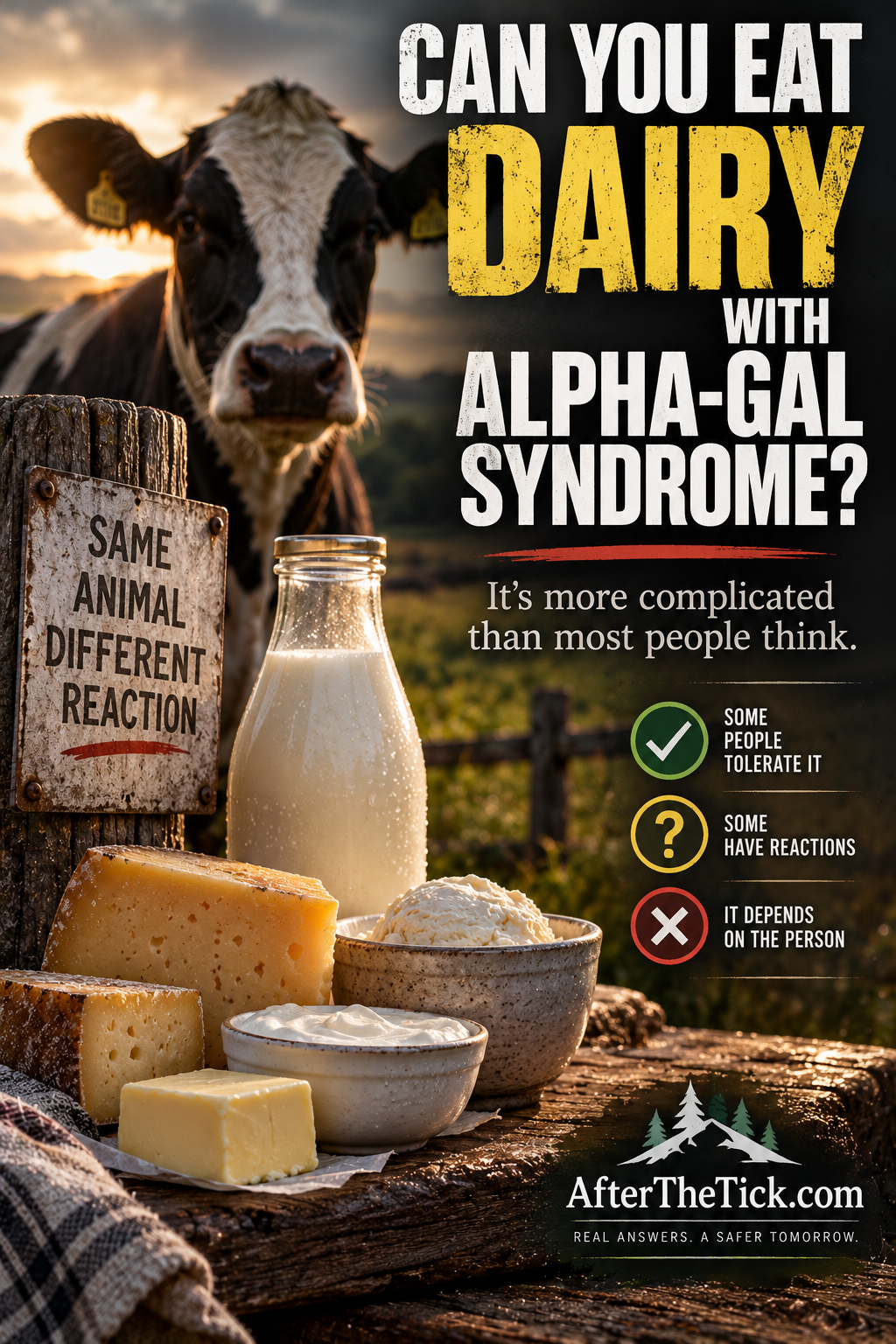
Giving up hamburgers and bacon after an Alpha-gal diagnosis is one thing. But then you open the refrigerator and start looking around.
Milk.
Cheese.
Butter.
Yogurt.
Sour cream.
That half-gallon of ice cream in the freezer.
Suddenly, you’re wondering whether all of that needs to go, too.
Here’s the part I think gets lost in a lot of Alpha-gal food discussions: many people with Alpha-gal syndrome can still eat dairy products. Others cannot. Readers weighing dairy alongside other foods and ingredients can use these everyday Alpha-gal questions as a broader reference.
Dairy can contain alpha-gal because it comes from mammals, but having Alpha-gal syndrome doesn’t automatically mean you have to eliminate every dairy product. That individual variation is also explained in understanding Alpha-gal reactions.
The CDC specifically acknowledges that many people with AGS tolerate milk products. Whether dairy belongs in your diet depends on your individual reactions and the guidance you receive from your healthcare provider.
And that’s where this gets a little more complicated than simply checking whether something came from a cow.
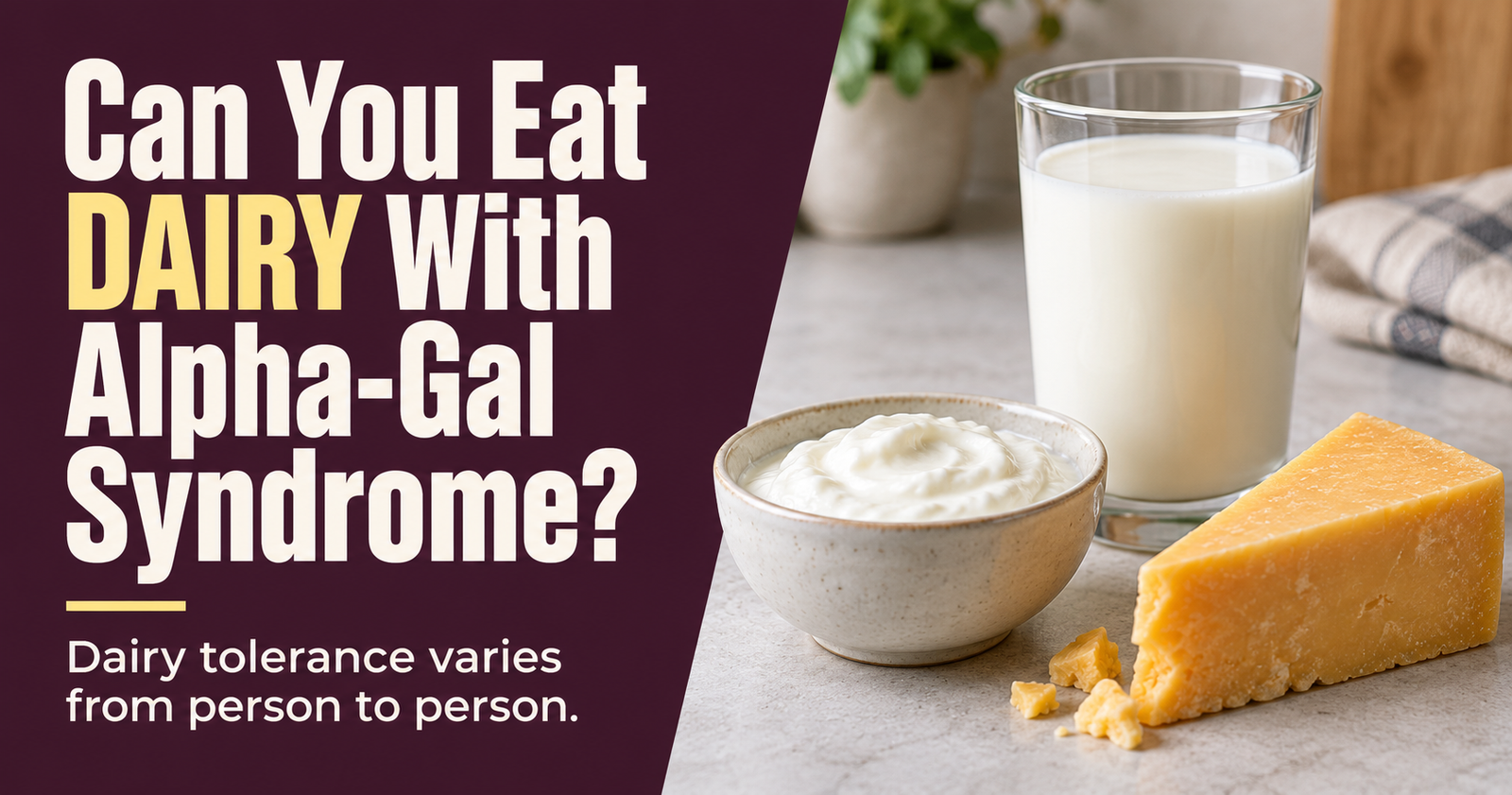
Why Dairy Is Different From Beef and Pork With Alpha-Gal
If you’ve been reading about Alpha-gal, you’ve probably noticed that beef, pork, lamb, and venison are usually the first foods mentioned.
There’s a reason for that.
People with AGS are generally more likely to react to mammalian meat than to dairy products.
Both can contain alpha-gal, but they aren’t necessarily equivalent exposures.
That’s an important distinction because someone newly diagnosed might assume:
Cow = Alpha-gal = everything from a cow must be completely avoided.
It isn’t always that simple.
The CDC recommends avoiding mammalian meat for most people diagnosed with AGS, while dairy restrictions depend on individual tolerance.
I would want that distinction explained before throwing away every dairy product in the refrigerator.
Does Milk Actually Contain Alpha-Gal?
Yes.
Cow’s milk can contain alpha-gal.
That means milk isn’t naturally free of the molecule responsible for Alpha-gal syndrome.
However, the presence of alpha-gal doesn’t automatically mean every person with AGS will react to that food.
That’s what makes this allergy frustrating.
One person may drink milk regularly without noticeable symptoms.
Another may experience digestive problems or other allergic symptoms after consuming dairy.
And some people may tolerate certain dairy products but have problems with others.
This is why I wouldn’t use somebody else’s Alpha-gal food list as the final authority on what belongs in my refrigerator.

Can You Drink Regular Cow’s Milk?
Some people with Alpha-gal syndrome can drink cow’s milk.
Others need to avoid it.
If I were newly diagnosed, I would want my allergist to answer this question specifically rather than assuming the answer is the same for everyone.
And I wouldn’t use a glass of milk as a home allergy test.
If you’ve already experienced symptoms after drinking milk, deliberately repeating the exposure to see whether it happens again could be dangerous.
Allergic reactions aren’t always predictable.
What About Whole Milk Versus Skim Milk?
This is where fat content enters the conversation.
Alpha-gal can be associated with mammalian fats and other components of dairy products.
Researchers have investigated whether the amount and type of fat in mammalian foods influence Alpha-gal reactions.
But I wouldn’t turn that into a simple rule that skim milk is safe and whole milk is dangerous.
Lower fat does not automatically mean Alpha-gal-free.
If dairy is a concern for you, the question needs to be addressed with your allergist rather than trying to determine safety from the percentage printed on the carton.
Can You Eat Cheese With Alpha-Gal Syndrome?
This is probably one of the biggest questions I’d have.
Because cheese shows up everywhere.
Pizza.
Sandwiches.
Tacos.
Salads.
Casseroles.
Macaroni and cheese.
Cheeseburgers.

Even foods that don’t look particularly cheesy can contain cheese or other dairy ingredients. The same label-reading concern applies to prepared chicken dishes, where sauces, broths, and cooking fats may matter; see ingredients in prepared chicken dishes.
The answer is that some people with AGS tolerate cheese, while others may need to avoid it.
Cheese made from cow, goat, or sheep milk is still mammalian dairy.
So switching from cow’s milk cheese to goat cheese doesn’t automatically remove the Alpha-gal concern.
Does Hard Cheese Make a Difference?
Different cheeses have different amounts of fat, moisture, protein, and other components.
But there isn’t a dependable rule that all hard cheeses are safe while soft cheeses aren’t.
I wouldn’t build my diet around a cheese-hardness chart I found online.
Instead, I’d want to know whether dairy is something my medical team considers appropriate for me and whether I’ve had any suspicious reactions.
What About Parmesan, Cheddar, and Mozzarella?
These are all commonly made from mammalian milk.
That means they aren’t automatically Alpha-gal-free.
However, that doesn’t mean every person with AGS must avoid them.
The same individual-tolerance principle applies.
And this is one reason I think dairy deserves its own article instead of being buried in a general Alpha-gal food list.
Cheese isn’t a yes-or-no question for everyone with AGS.
Butter Is Another Food Worth Discussing
Butter can be especially confusing because it’s a dairy product that’s largely fat.
You might not think twice about the little bit used to cook eggs or vegetables.
But if dairy or mammalian fat is a trigger for your particular AGS, butter could matter.
I’d think about all the places butter can appear:
- Toast and biscuits
- Mashed potatoes
- Scrambled eggs
- Baked goods
- Restaurant vegetables
- Sauces and gravies
- Popcorn
- Desserts
The problem isn’t necessarily that someone sits down and eats a stick of butter.
It’s that butter can be used in foods that otherwise look completely unrelated to dairy.
Is Margarine a Better Choice?
Potentially, depending on the ingredients.
Some margarines and plant-based spreads are made primarily from vegetable oils.
Others contain dairy-derived ingredients.
I wouldn’t assume a product is dairy-free simply because the package says margarine.
I’d check the ingredients and choose something compatible with my individual avoidance plan.
What About Yogurt?
Yogurt is another mammalian dairy product when made from cow’s, goat’s, or sheep’s milk.
Some people with AGS may tolerate it.
Others may not.
One thing I wouldn’t assume is that fermentation automatically eliminates alpha-gal.
Yogurt being fermented doesn’t make it guaranteed safe for somebody who reacts to mammalian dairy.
Fortunately, there are also yogurts made from ingredients such as coconut, soy, oats, and almonds.
Those plant ingredients don’t naturally contain alpha-gal, although packaged products still deserve an ingredient check.
Can You Eat Ice Cream With Alpha-Gal?
Ice cream is where I’d be particularly careful about making assumptions.
Traditional ice cream commonly contains milk and cream.
Some varieties contain additional dairy ingredients.
Others have gelatin or other ingredients that could matter for certain people with AGS.
And because ice cream can contain substantial amounts of dairy fat, it isn’t necessarily equivalent to a small amount of milk used in another food.
But again, I wouldn’t claim that every person with AGS will react to ice cream.
Individual tolerance varies.
What About Dairy-Free Ice Cream?
This is where grocery shopping gets a little more encouraging.
There are frozen desserts made with coconut milk, oat milk, almond milk, soy milk, and other plant-based ingredients.
These can be useful alternatives for someone who needs to avoid mammalian dairy.
I’d still read the ingredient list.
Dairy-free doesn’t automatically mean free from every ingredient that could concern a particularly sensitive person.
But it can make finding a dessert much easier.
Why Can Someone Tolerate Cheese but React to Ice Cream?
This is one of those situations where I’d resist trying to explain everything with one ingredient.
Different dairy products vary in composition, serving size, fat content, and additional ingredients.
The circumstances around a meal can also matter.
And not every symptom after eating dairy is necessarily caused by Alpha-gal.
For example, someone could have lactose intolerance, which is a different condition.
So if one dairy product seems to cause problems while another doesn’t, I wouldn’t immediately assume I’ve discovered a universal Alpha-gal rule.
I’d document the specific foods, amounts, timing, and symptoms and discuss the pattern with a healthcare professional.

Alpha-Gal and Lactose Intolerance Are Not the Same Thing
This distinction is important.
Lactose intolerance involves difficulty digesting lactose, the sugar naturally found in milk.
Alpha-gal syndrome involves an immune response to alpha-gal.
Those are completely different mechanisms.
Someone with lactose intolerance may experience bloating, gas, diarrhea, or stomach discomfort after consuming dairy.
Someone with AGS may also experience digestive symptoms, but the underlying cause is different.
Would Lactose-Free Milk Be Safe With Alpha-Gal?
Not necessarily.
Lactose-free cow’s milk is still cow’s milk.
Removing or breaking down lactose doesn’t automatically remove alpha-gal.
That’s why I wouldn’t assume lactose-free milk is an appropriate substitute for someone whose Alpha-gal management plan requires avoiding mammalian dairy.
The same goes for lactose-free cheese and other lactose-free dairy products.
Lactose-free and Alpha-gal-free are not interchangeable terms.
Could Dairy Cause a Delayed Alpha-Gal Reaction?
Yes.
Alpha-gal reactions after consuming food are known for sometimes being delayed several hours.
The CDC describes symptoms as typically occurring 2 to 6 hours after exposure, although reactions can vary.
That’s what makes the timing so important.
Imagine having ice cream after dinner.
You feel fine afterward.
You watch television.
You go to bed.
Then you wake up several hours later with stomach cramps, itching, or another symptom.
Would I immediately blame the ice cream?
No.
There are other possible explanations.
But if similar delayed reactions repeatedly follow mammalian dairy, that’s a pattern I’d want to document.

I explain the timing issue more thoroughly in our article about why Alpha-gal reactions can begin hours after eating.
That delayed pattern is one of the reasons AGS can be difficult to recognize.
What If Dairy Only Causes Stomach Problems?
This is another question worth taking seriously.
Not everyone with AGS develops hives or swelling.
Some people experience gastrointestinal symptoms without obvious skin symptoms.
Those can include abdominal pain, cramping, diarrhea, nausea, or vomiting.
However, dairy can cause digestive symptoms for plenty of reasons unrelated to Alpha-gal.
That’s why I wouldn’t diagnose a dairy-related Alpha-gal reaction simply because milk upsets my stomach.
The pattern matters.
Your history matters.
Testing and medical evaluation matter.

If you’re dealing with recurring digestive episodes but never develop hives, our article about Alpha-gal stomach problems without a rash explains why gastrointestinal-only reactions deserve attention.
Should Everyone With Alpha-Gal Stop Eating Dairy?
No.
This is one of the clearest distinctions in current CDC guidance.
Many people with AGS tolerate milk products.
That doesn’t mean dairy is safe for everyone.
It means dairy avoidance needs to be individualized.

I would not recommend eliminating every dairy product solely because someone received a positive Alpha-gal blood test. Before making that dietary decision, it helps to review what a positive Alpha-gal blood test means rather than treating the result as a diagnosis by itself.
And I wouldn’t recommend continuing to eat dairy if a healthcare professional has told you to avoid it or you’ve experienced reactions that require evaluation.
Those decisions need to be based on your medical situation.
For someone who has already removed mammalian meat from their diet, unnecessarily eliminating additional foods can also make getting adequate nutrition more difficult.
That’s another reason to work with an allergist and, when appropriate, a registered dietitian.
If You Need to Avoid Dairy, What Can You Use Instead?
This is where I’d focus on making everyday meals easier rather than trying to recreate every dairy product perfectly.
There are several plant-based alternatives worth investigating.
Milk Alternatives
Soy milk, oat milk, almond milk, coconut milk, and other plant-based beverages can provide alternatives to mammalian milk.
The best option depends on your preferences, nutritional needs, other allergies, and the ingredients in the specific product.
One thing I’d check is whether the replacement provides enough protein and calcium for how I plan to use it.
For example, a plant-based beverage isn’t automatically nutritionally equivalent to cow’s milk.
Butter Alternatives
Plant-based spreads and cooking oils can replace butter in many recipes.
Olive oil, avocado oil, and canola oil are useful cooking options.
For baking, the right replacement depends on the recipe.
Cheese Alternatives
Plant-based cheeses are available, although texture, flavor, and melting performance vary considerably.
I’d rather find one that works well in a favorite meal than buy six expensive packages and hope for the best.
Yogurt Alternatives
Coconut, soy, almond, and oat-based yogurts are options.
Again, the ingredient list and nutritional profile matter.
Ice Cream Alternatives
Plant-based frozen desserts can make this one of the easier substitutions.
The important thing is finding something you actually enjoy rather than settling for a replacement you dislike just because it says dairy-free.
My Approach Would Be to Keep Meals Familiar
If dairy had to come out of my diet, I wouldn’t immediately reinvent every meal.
I’d start with what I already eat.
If breakfast is oatmeal with milk, I’d investigate a suitable plant-based milk.
If dinner is chicken and mashed potatoes, I’d work out a butter and milk substitute that fits.
If tacos usually have cheese, I’d try an alternative or find toppings that make the meal satisfying without it.
If ice cream is a favorite dessert, I’d find a frozen dessert I actually like.
That’s a much more manageable approach than treating an Alpha-gal diagnosis as a reason to replace the entire kitchen overnight.
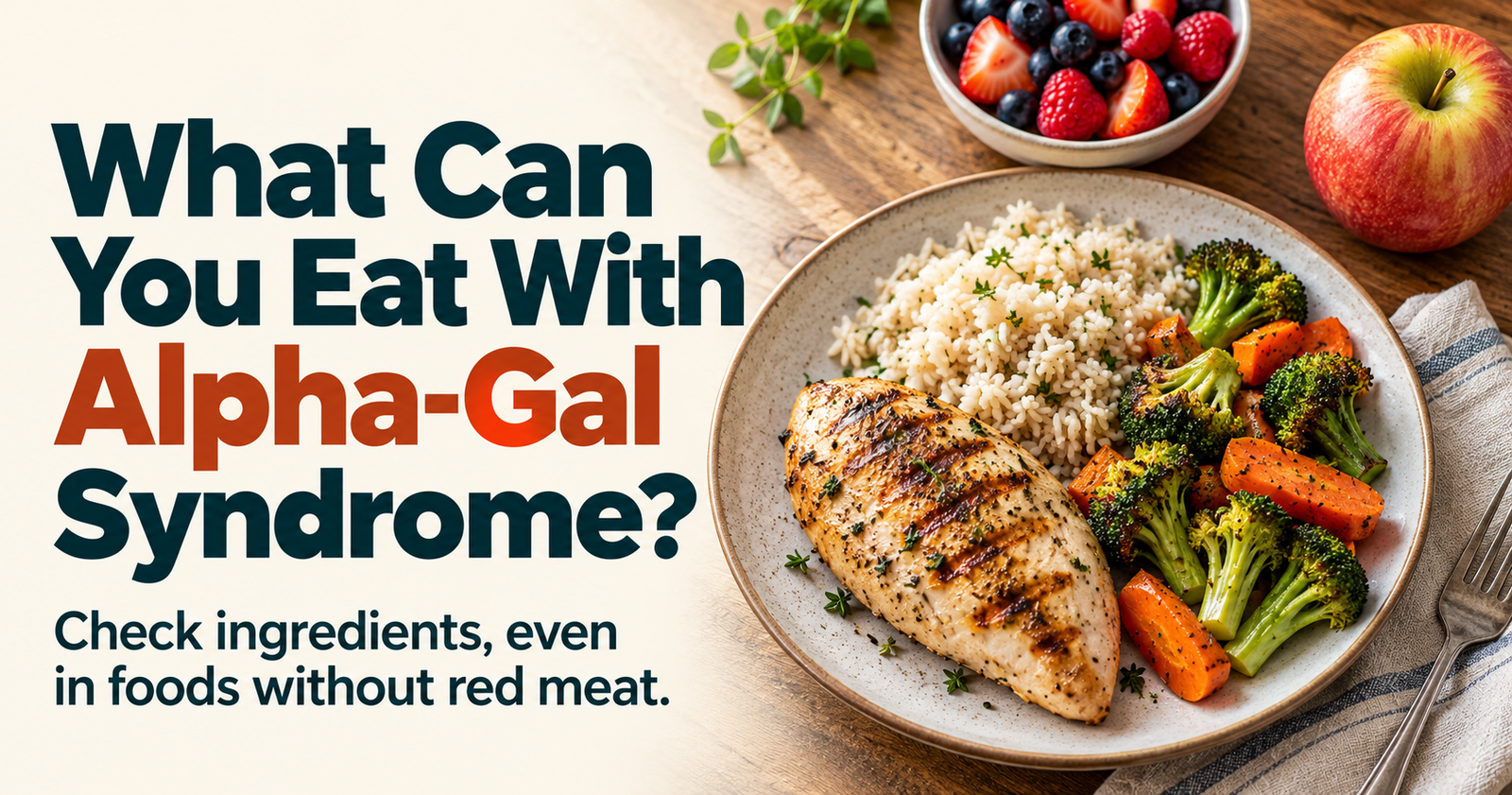
And if you’re still sorting out your overall food options, our broader guide to what you can eat with Alpha-gal syndromeis a useful starting point.
What I’d Ask My Allergist About Dairy
I wouldn’t leave an appointment with a vague instruction to avoid red meat and then spend the next month guessing about milk.
I’d ask specific questions.
Do I personally need to avoid dairy?
This is the main question.
Does my reaction history suggest dairy is a trigger?
The answer should involve more than simply knowing that milk comes from mammals.
Should I avoid all dairy products or only certain exposures?
Don’t make this decision by experimenting with foods that may have caused reactions.
How should I handle packaged foods containing milk ingredients?
This matters because dairy appears in many prepared foods.
What should I do if I accidentally consume something that triggers a reaction?
You need an individualized emergency plan, especially if you’ve experienced significant allergic symptoms.
Reading Dairy Labels Without Making Yourself Crazy

One thing I would remember is that food labels are designed to identify certain major allergens, but Alpha-gal itself isn’t one of the nine major food allergens under U.S. labeling law.
Milk is a major allergen, so packaged foods containing milk ingredients generally must identify milk under applicable labeling requirements.
That’s helpful if you need to avoid dairy.
But it doesn’t mean a product without a milk warning is automatically free from every possible mammalian ingredient.
Gelatin, animal fats, and other ingredients can create separate questions.
So I wouldn’t rely exclusively on the bold allergen statement.
I’d read the ingredient list too.
And if the source of an ingredient genuinely matters for my level of sensitivity, I’d contact the manufacturer rather than guessing.
Can Dairy Tolerance Change Over Time?
Alpha-gal syndrome can change over time.
Some people experience declining sensitivity, particularly when additional tick bites are avoided.
However, that doesn’t mean dairy tolerance follows a predictable schedule.
I wouldn’t assume that tolerating dairy today guarantees I’ll always tolerate it.
And I wouldn’t assume that avoiding dairy for six months means I can automatically start eating it again.

If you’re curious about the longer-term picture, we’ve also covered whether Alpha-gal syndrome can improve over time.
Any decision to reintroduce a food that previously caused an allergic reaction should involve appropriate medical guidance.
Don’t Let Somebody Else’s Dairy Rules Become Yours
This is where I’d be careful with social media groups.
Someone may say:
“I eat cheese every day and I’m fine.”
Another person may say:
“I can’t tolerate even a little butter.”
Both experiences may be genuine.
But neither person’s experience determines what your immune system will do.
Alpha-gal is individual.
That’s why I wouldn’t build my entire diet around the most restrictive story I can find online.
I’d want to understand my diagnosis, my reaction history, and the recommendations from my healthcare provider.
If dairy is something I can safely keep, that’s one less part of everyday life I have to change.
If dairy needs to go, there are still plenty of ways to make familiar meals work.
The important thing is knowing why I’m avoiding something, rather than being afraid of every food that came from an animal.
Calla Mercer writes about the everyday food decisions that come with Alpha-gal syndrome, from grocery shopping and family meals to navigating ingredients and eating out. Find more practical food guides at After The Tick.