
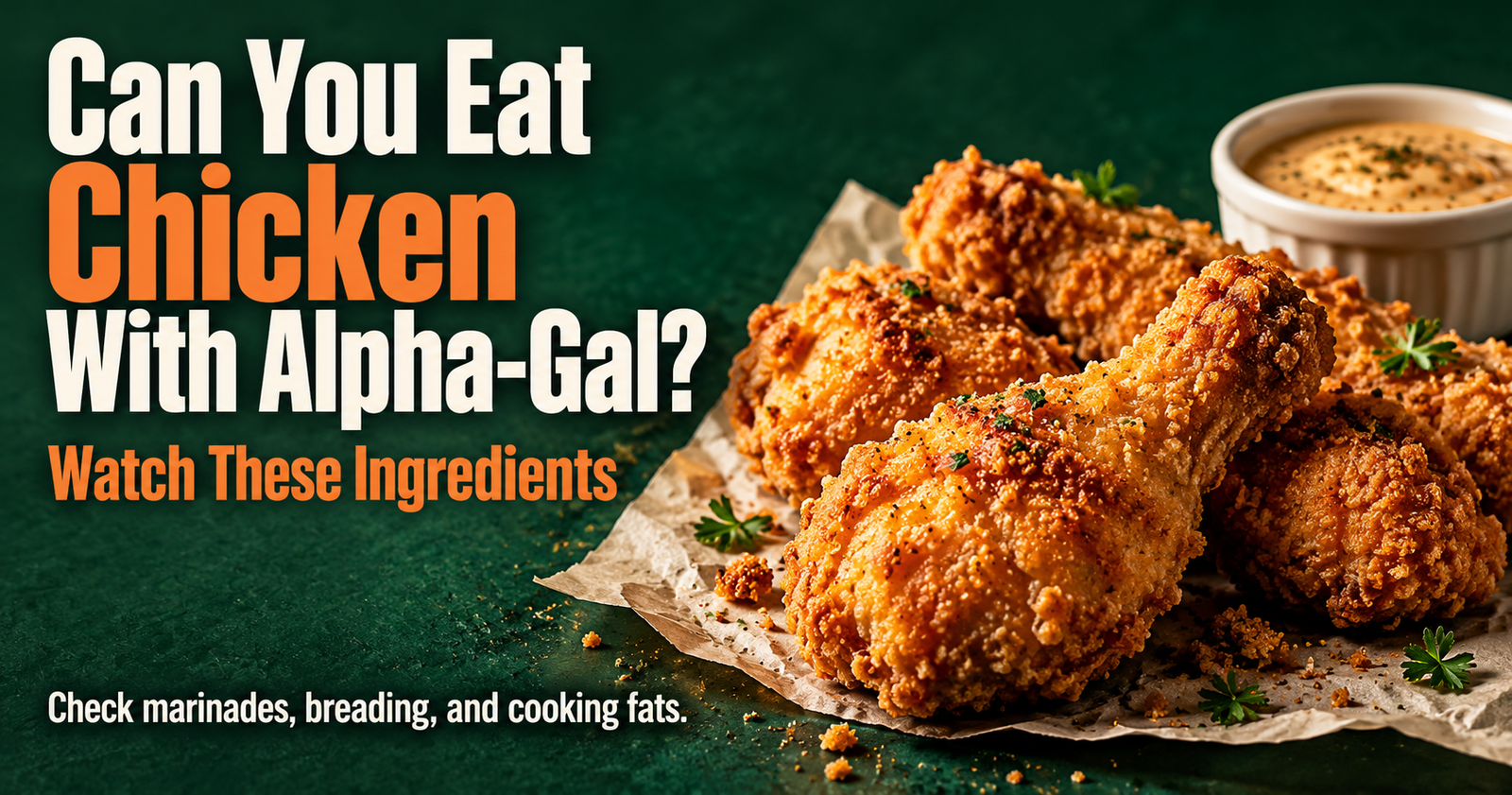
Chicken is one of the first foods worth understanding when you’re trying to figure out what dinner looks like after an Alpha-gal diagnosis. For related questions about chicken, dairy, meat, symptoms, and other everyday choices, see these Alpha-gal food questions.
The good news is that chicken doesn’t naturally contain alpha-gal.
Chickens are birds, not mammals. That means plain chicken is fundamentally different from beef, pork, lamb, and venison when it comes to Alpha-gal syndrome. The mammal-versus-bird distinction is central to understanding why Mammalian meat such as beef, pork, lamb, venison, and rabbit can be a misleading shorthand.
But there’s a catch.
The chicken itself might be fine, while the ingredients used to prepare it create a problem.
Bacon grease in the skillet. Beef broth in the sauce. Butter in the mashed potatoes. A gravy made with meat drippings.
That’s where an ordinary chicken dinner can become more complicated than it looks.
Yes, Chicken Is Generally an Option With Alpha-Gal Syndrome
The CDC specifically identifies chicken and other poultry as foods that don’t naturally contain alpha-gal.
That includes:
- Chicken
- Turkey
- Duck
- Quail
These are birds rather than mammals.
For someone whose Alpha-gal management plan requires avoiding mammalian meat, poultry can provide an important source of protein.
And that’s a pretty big deal.
Chicken can be grilled, baked, roasted, shredded, sautéed, or cooked in a slow cooker. It works in soups, sandwiches, tacos, casseroles, salads, and plenty of other everyday meals.
You don’t necessarily need expensive specialty products to put dinner together.
Plain chicken gives you a familiar starting point.
Of course, someone can have an unrelated chicken allergy, and every person’s medical situation is different. But Alpha-gal itself isn’t naturally present in chicken meat.
The First Thing That Matters Is How the Chicken Was Prepared
This is where the question becomes more interesting.
Think about two chicken breasts.
The first is seasoned with salt, pepper, garlic, and olive oil before being grilled.
The second is cooked in bacon grease and served with a sauce containing beef stock.
Both are chicken.
But they’re not the same meal.
For someone who needs to avoid mammalian fats and broths, the second preparation introduces ingredients that deserve attention.
Cooking oil makes a difference
Olive oil, canola oil, sunflower oil, and other plant-derived cooking oils don’t naturally contain alpha-gal.
Lard and beef tallow are different because they come from mammals.
That means checking the cooking fat can be just as important as checking the protein.
This comes up with fried chicken, skillet chicken, roasted chicken, and restaurant meals.

It’s one of the reasons I think learning to read food labels with Alpha-gal syndrome is such a useful skill.
Once you know what ingredients deserve attention, you can evaluate the whole meal instead of just the meat. For the broader picture, see Alpha-gal food and label guide before building your own meal-by-meal approach.

Can You Eat Fried Chicken With Alpha-Gal Syndrome?
Fried chicken can be an option, but I wouldn’t treat every fried chicken product as identical.
The chicken itself isn’t the concern.
The questions involve the breading, frying fat, seasonings, and preparation.
What oil is used?
Chicken fried in a suitable plant oil is different from chicken fried in lard or beef tallow.
That’s a question worth asking at restaurants.
What’s in the breading?
Breading may contain flour, starch, seasonings, milk, buttermilk, or other ingredients.
Dairy matters for some people with AGS but is tolerated by many others.
So I wouldn’t automatically eliminate every fried chicken recipe containing buttermilk.
I’d follow the individual avoidance plan established with an allergist.
What else goes into the fryer?
Restaurants may use shared fryers for multiple foods.
Whether that matters depends on the ingredients involved, the preparation process, and the person’s individual sensitivity.
Someone with a history of reacting to small amounts of mammalian ingredients may need more precautions than someone whose restrictions are limited to mammalian meat.
The important thing is not to assume that every person with Alpha-gal needs identical restaurant rules.
Can You Eat Rotisserie Chicken With Alpha-Gal?
Rotisserie chicken is convenient.
You can grab one at the grocery store, bring it home, and have dinner ready without cooking from scratch.
But I would still check the ingredients.
Not because rotisserie chicken automatically contains alpha-gal.
Because prepared chicken products can contain additional ingredients.
What can be added to rotisserie chicken?
Depending on the product, a rotisserie chicken may contain seasonings, flavorings, broth, added solutions, or other ingredients.
Some formulations are relatively simple.
Others are more complicated.
I wouldn’t assume that every rotisserie chicken sold under a particular store name has the same ingredients forever.
The package is more useful than the display case
If the chicken is packaged, the ingredient list is where I’d start.
If it’s sold hot from a deli counter, the store may have ingredient information available separately.
I’d ask for that information before relying on the product.
And once I found a particular rotisserie chicken that fit my needs, I’d save the product details so I wouldn’t have to start from scratch every shopping trip.


What About Chicken Broth?
Chicken broth is another ingredient that deserves a little attention.
Chicken itself doesn’t contain alpha-gal.
A broth made from chicken, water, vegetables, and suitable seasonings doesn’t naturally introduce alpha-gal through the chicken.
But packaged broth can contain additional ingredients.
And homemade broth depends on what goes into the pot.
The difference between chicken broth and beef broth
This sounds obvious, but it matters.
Chicken broth is generally made from poultry.
Beef broth comes from a mammal.
For someone avoiding mammalian meat products, those aren’t interchangeable.
The same goes for bouillon cubes, concentrated soup bases, and powdered soup mixes.
I would read the ingredients rather than assuming the word “broth” tells me everything.
Chicken soup can still contain mammalian ingredients
A chicken soup might contain cream.
A restaurant soup might use a mixed stock.
A packaged soup may contain ingredients that aren’t obvious from the picture on the front.
That’s why I pay more attention to the actual recipe than the name of the dish.
A bowl labeled chicken soup tells me what the main ingredient probably is.
It doesn’t tell me everything in the bowl.
Can You Eat Chicken Cooked in Butter?
This depends on your individual dairy tolerance.
Butter comes from milk, which is a mammalian product.
However, many people with Alpha-gal syndrome tolerate dairy.
Others don’t.
So I wouldn’t make a blanket statement that chicken cooked in butter is unsafe for everyone with AGS.
If dairy is part of your avoidance plan, butter is an ingredient to consider.
If your allergist has confirmed that dairy is something you can continue consuming, the situation may be different.

We’ve covered this more thoroughly in our article about eating dairy with Alpha-gal syndrome.
The point is that chicken doesn’t become mammalian meat because butter was added.
But the finished dish can contain a separate alpha-gal source.
Why Bacon-Wrapped Chicken Is a Different Story
Bacon-wrapped chicken is a perfect example of why the main protein isn’t enough to evaluate a meal.
Chicken is poultry.
Bacon comes from pigs.
Pigs are mammals.
So wrapping chicken in bacon introduces mammalian meat.
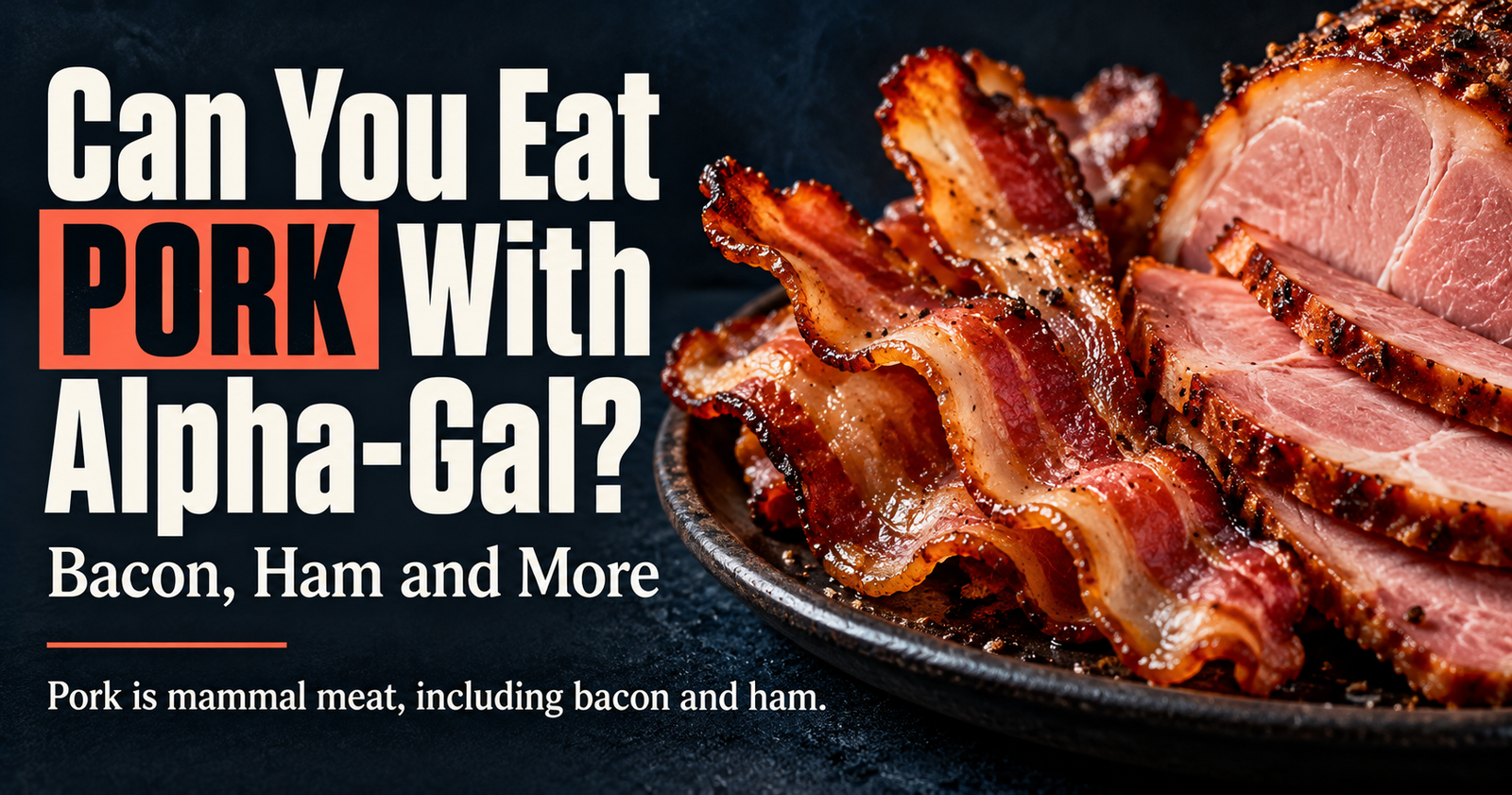
The same concern applies to chicken dishes topped with bacon pieces, cooked with pork sausage, or prepared using bacon drippings. The discussion of pork ingredients in chicken dishes explains why those additions deserve separate attention from the chicken itself.
For someone avoiding mammalian meat, removing the visible bacon afterward isn’t a dependable way to establish that the remaining dish is suitable.
The food has already been prepared with the ingredient.
That’s why I prefer to know how a meal is being cooked before it’s served rather than trying to fix it afterward.
Chicken Sausage Isn’t Automatically Mammal-Free
This is one of those grocery-store products where reading the front of the package isn’t enough.
A package might say:
Chicken Sausage
That tells you chicken is involved.
It doesn’t necessarily tell you every ingredient.
Some poultry sausages may use casings derived from mammals or contain additional ingredients that need investigation.
Other products use different casings or formulations.
What I’d check on chicken sausage
The actual meat ingredients come first.
Then the casing.
Then the seasonings, fats, and other added ingredients.
If the package says pork casing, that’s useful information.
If the casing source isn’t identified and mammalian casings are part of my avoidance plan, I’d contact the manufacturer.
That’s a much better approach than assuming all chicken sausage is unsuitable or automatically suitable.



Turkey Bacon and Turkey Sausage Need the Same Attention
Turkey is poultry, so turkey meat doesn’t naturally contain alpha-gal.
But packaged turkey bacon and turkey sausage are manufactured foods.
Their ingredient lists can vary.
I wouldn’t assume that a turkey product contains pork just because it’s designed to resemble bacon.
And I wouldn’t assume that it contains only turkey because the front says turkey.
I’d read the actual ingredients.
That’s especially important with products containing added fats, flavorings, or casings.
A product with a simple, clearly identified ingredient list can make shopping considerably easier.
What About Chicken Nuggets?
Chicken nuggets are another everyday food that can be more complicated than plain chicken.
They’re often made with chicken, breading, seasonings, and other ingredients.
Some contain milk ingredients.
Some may contain flavorings or added fats that deserve investigation.
And different brands can have very different formulations.
Frozen nuggets versus restaurant nuggets
With frozen nuggets, I can usually inspect the package.
With restaurant nuggets, I may need to check the restaurant’s ingredient information or ask questions.
The restaurant may also use shared cooking equipment.
I wouldn’t assume every frozen nugget or restaurant nugget is the same.
The product matters.
The ingredients matter.
And the individual avoidance plan matters.
Can You Eat Chicken at Restaurants With Alpha-Gal?
Restaurant chicken is where I stop asking only, “Is this chicken?”
I already know chicken itself isn’t a mammal.
What I need to know is what happened to that chicken between the refrigerator and my plate.
Was it cooked in butter?
Was bacon grease involved?
Does the sauce contain beef stock?
Is there cheese on it?
Does the seasoning contain something I need to investigate?
Was it cooked on the same surface as burgers or bacon?
Those questions tell me much more than the word chicken on the menu.
How I Order Grilled Chicken
Plain grilled chicken is one of the first things I look for when I want a relatively simple restaurant meal.
But “grilled” doesn’t automatically mean plain.
Restaurants may brush chicken with butter, use a marinade, add seasoning blends, or cook it on a shared grill.
So instead of giving the server my entire Alpha-gal story, I keep my questions specific.
I might ask:
“Is the chicken cooked with butter, beef fat, bacon grease, lard, or another animal fat?”
Then:
“Is there any beef or pork in the marinade, seasoning, sauce, or broth?”
Those are questions the kitchen can actually answer.
If dairy is something I personally tolerate, I don’t need to complicate the conversation by avoiding butter unnecessarily. That’s why knowing my own Alpha-gal restrictions matters before I ever sit down at the table.
I Don’t Ask Whether Something Is “Alpha-Gal Safe”
I’ve learned that this question usually isn’t very useful:
“Is this Alpha-gal safe?”
A server may have never heard of Alpha-gal syndrome.
Even somebody who has heard of it may not understand my particular sensitivity.
So I translate Alpha-gal into ingredients.
Instead of asking whether the grilled chicken is safe, I ask what it’s cooked with.
Instead of asking whether the soup is safe, I ask what broth is used.
Instead of asking whether the vegetables are safe, I ask whether bacon, ham, butter, or animal fat is used in them.
Specific questions get specific answers.
That’s a skill we’ll build much further in the Cooking and Eating Out section because eating at a restaurant is a completely different experience from reading a package at home.
Chicken Sandwiches Can Get Complicated Fast
A grilled chicken sandwich sounds simple.
Then I break down the entire sandwich.
Chicken.
Bun.
Cheese.
Bacon.
Sauce.
Cooking fat.
Seasoning.
Suddenly, the chicken is only one part of the meal.
If I tolerate dairy, cheese may not be a concern for me.
Bacon is different because it comes from pork.
A creamy sauce may contain dairy.
The bun has its own ingredient list.
Some restaurants brush buns with butter.
That’s why I don’t treat “chicken sandwich” as one ingredient.
I treat it as several ingredients assembled together.
Fast-Food Chicken Isn’t All the Same
Fast food can actually be easier in one respect because major chains often publish detailed ingredient and allergen information.
I can sometimes look at the menu before leaving home.
That’s much easier than trying to research everything while people are waiting behind me at the counter.
But I still check the exact product.
A grilled chicken sandwich and crispy chicken sandwich from the same restaurant can have completely different ingredients.
Nuggets can have another formulation.
Sauces introduce another set of ingredients.
And recipes change.
I check current information
I don’t rely on an old social-media post saying:
“I eat this all the time and I’m fine.”
That person’s tolerance isn’t mine.
And the restaurant may have changed its ingredients since the post was written.
I want the restaurant’s current ingredient information whenever possible.
Shared Grills Are Something I Discuss Based on My Own Sensitivity
Cross-contact gets complicated because Alpha-gal sensitivity varies so much.
A restaurant may cook chicken on the same grill used for hamburgers.
For some people with AGS, that may be an unacceptable situation based on their reaction history and allergist’s guidance.
Others may have different precautions.
I don’t think it’s useful to tell every person with Alpha-gal that they need exactly the same restaurant protocol.
I follow the level of avoidance appropriate for me.
And when I don’t know what level I need, that’s a medical question for my allergist, not something I settle by copying the strictest restaurant rules I can find online.
Cooking Chicken at Home Is Where I Get the Most Control
Home cooking is considerably easier because I know what’s going into the pan.
Plain chicken gives me a blank canvas.
I can season it myself.
Choose the cooking oil.
Choose the sauce.
Choose the sides.
And know exactly what broth went into the recipe.
That makes chicken one of the easiest proteins for me to build meals around.
My Basic Baked Chicken Doesn’t Need Anything Fancy
I don’t need an “Alpha-gal recipe” for every dinner.
That’s something I think gets overcomplicated.
A basic chicken dinner can be:
Chicken breast or thighs.
Olive oil.
Salt.
Pepper.
Garlic.
Herbs or a seasoning blend I’ve already checked.
Then vegetables and potatoes or rice on the side.
That’s ordinary food.
Nobody else at the table has to feel like they’re eating a special medical diet.
And I don’t have to prepare two completely different dinners.
Tacos Are Another Easy Chicken Meal
Chicken tacos are one of those meals where everybody can build their own plate.
I can cook chicken with seasonings I’ve checked.
Add tortillas.
Lettuce.
Tomatoes.
Salsa.
Beans.
Rice.
Avocado.
Then dairy toppings can be handled individually.
If I tolerate cheese and sour cream, that’s easy.
If I don’t, I leave them off or use alternatives that work for me.
The whole family doesn’t need to follow the exact same restrictions for dinner to work.
That’s the kind of meal I like because Alpha-gal doesn’t become the center of the evening.
Chicken and Rice Gives Me a Lot of Flexibility
Chicken and rice can go in dozens of directions.
Simple seasoned chicken over white rice.
Chicken with vegetables.
A stir-fry.
A rice bowl.
A casserole.
Chicken soup.
The main thing I watch is what liquid, fat, and sauce I’m adding.
A recipe calling for beef broth gets changed.
If it calls for a dairy ingredient I personally avoid, I find an appropriate substitute.
I don’t necessarily abandon the entire recipe because one ingredient doesn’t work.
I change the ingredient.
Slow-Cooker Chicken Is Where Broth Can Sneak In
Slow-cooker recipes love broth.
They also love packaged seasoning mixes, cream soups, gravy packets, and sauces.
That’s why I read the recipe all the way through before dumping everything into the slow cooker.
Chicken itself may be completely straightforward.
Then the recipe calls for:
A can of cream soup.
A gravy packet.
A cup of broth.
Butter.
That’s where I decide what fits my individual plan and what needs replacing.
The good news is that once I find substitutions that work, I save them.
Next time, I don’t have to solve the recipe again.
Chicken Casseroles Need the Same Ingredient-by-Ingredient Approach
Casseroles can look intimidating because there are so many ingredients.
But I break them down.
Chicken?
Fine from an Alpha-gal standpoint.
Pasta or rice?
Check the specific product if needed.
Cream soup?
Read the label.
Cheese?
Depends on my dairy tolerance.
Broth?
Check the source.
Butter?
Again, depends on my dairy plan.
Once I separate the casserole into pieces, it becomes much easier.
That’s how I handle most Alpha-gal food questions now.
Break the meal apart instead of deciding whether the whole dish is “safe” based on its name.
Chicken Salad Can Be an Easy Lunch
Chicken salad is another food where the basic idea is simple.
Cooked chicken.
Mayonnaise.
Celery.
Seasonings.
Maybe grapes, nuts, onions, or other additions depending on the recipe.
I still check the ingredients in the mayonnaise and any packaged additions I use.
But once I find products that work for me, I can make the same recipe without researching it every time.
That’s exactly what I want.
I don’t want Alpha-gal to require an investigation every time I make lunch.
Leftover Chicken Makes the Next Day Easier
One practical habit I like is cooking extra chicken.
If I’m already grilling or baking chicken for dinner, making a few extra pieces gives me options the next day.
Chicken salad.
A sandwich.
A wrap.
Chicken over rice.
Chicken tacos.
A salad topped with sliced chicken.
That means fewer packaged convenience foods to research when I’m hungry and in a hurry.
It also gives me something I already know the ingredients of.
There’s a lot of value in having known food ready to eat.
I Keep Chicken Simple When I’m Trying a New Sauce
If I’m trying a new barbecue sauce, marinade, dressing, or seasoning, I don’t need to introduce five unfamiliar products at the same meal.
I keep the rest of dinner familiar.
That way, if I have a problem later, I have a much shorter list of new ingredients to investigate.
I’m not doing this because I expect every new food to cause a reaction.

I’m doing it because delayed Alpha-gal reactions can make figuring out a trigger frustrating. Understanding the usual window of 2 to 6 hours after exposure can make that trigger-tracking process more manageable.
Knowing exactly what changed makes that job easier.
Barbecue Sauce Isn’t Automatically a Problem
I don’t assume barbecue sauce contains mammalian ingredients.
I read the label.
Many sauces are built around tomato, vinegar, sugar or molasses, spices, and flavorings.
Others may contain ingredients that deserve more investigation.
Again, I don’t ban the entire category.
I find products that work for my needs.
Then I keep buying them.
The same strategy works for marinades, salad dressings, hot sauces, and dipping sauces.
Chicken Gravy Is One I’d Check Carefully
The word chicken on a gravy packet doesn’t necessarily tell me everything in it.
I check the actual ingredients.
I want to know what fat and broth are used.
I want to know whether dairy is present if dairy matters for me.
And I don’t assume homemade gravy is automatically simpler.
If someone makes “chicken gravy” using butter, chicken drippings, and chicken broth, that’s one formulation.
If they add another meat stock or mammalian fat, that’s another.
The recipe matters more than the name.
What About Chicken Cooked on a Grill After Burgers?
This is another cross-contact question where individual sensitivity matters.
If hamburgers were cooked on the grill immediately before the chicken, mammalian fat and residue may remain on the cooking surface.
How much precaution a particular person needs around that situation should be based on their reaction history and medical guidance.
At home, I have more control.
I can clean the grill.
Use a separate area.
Use foil or another cooking surface when appropriate.
Or organize cooking in whatever way fits my individual precautions.
I don’t think everybody with Alpha-gal needs to become afraid of grills.
I think they need to know what level of cross-contact matters for them.
Family Cookouts Get Easier When People Know the Specific Rule
Telling family:
“I have Alpha-gal syndrome.”
may not tell them much.
Telling them:
“Please don’t wrap my chicken in bacon or cook it in the same bacon grease”
is much clearer.
If I have specific cross-contact needs, I explain those too.
People usually do better when I give them a concrete task instead of expecting them to understand an allergy they’ve never dealt with.
And if I’m unsure what will be served, bringing something I know I can eat removes a lot of stress.
Chicken Doesn’t Need to Feel Like the Boring Replacement for Beef
I wouldn’t want to spend years thinking:
“Well, I guess I have to eat chicken again.”
Chicken is versatile enough that it doesn’t need to feel like punishment.
Grilled chicken.
Smoked chicken prepared with ingredients that work for me.
Chicken tacos.
Chicken pasta.
Chicken curry.
Stir-fry.
Chicken sandwiches.
Chicken salad.
Roasted chicken.
Chicken soup.
Chicken and rice.
Different seasonings and cooking methods make these completely different meals.
Losing or limiting certain mammalian foods doesn’t mean every dinner has to become a dry chicken breast and steamed broccoli.
The Bigger Lesson Isn’t Really About Chicken
Chicken is actually the easy part.
It’s poultry. It doesn’t naturally contain alpha-gal.
The bigger lesson is learning to look at the entire meal.
What cooked the chicken?
What’s in the sauce?
What broth was used?
Was bacon added?
Does dairy matter for me?
What’s in the breading?
Is there a casing on that chicken sausage?
Those are the questions that turn a vague fear of food into something manageable.
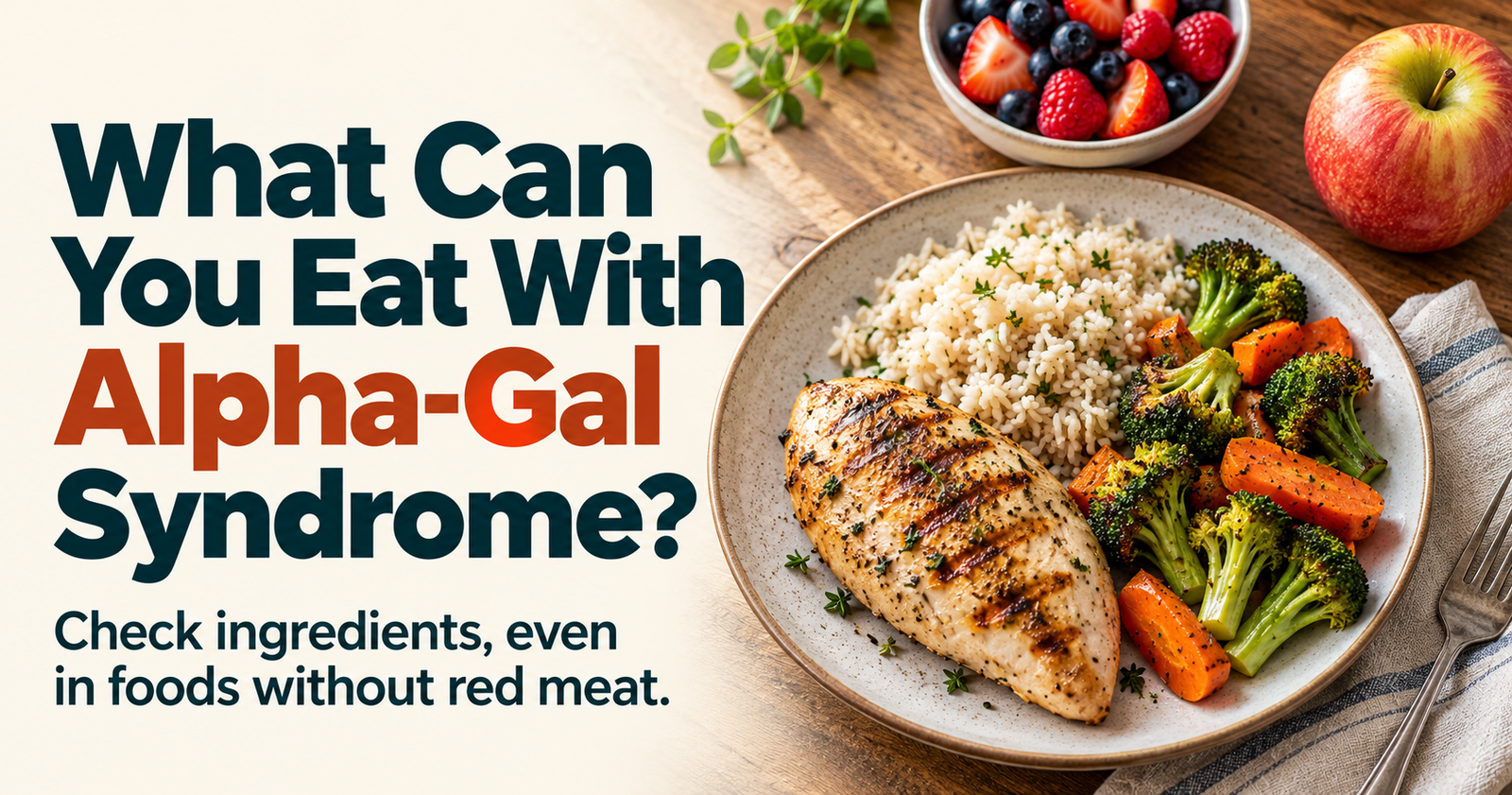
That’s why our broader guide to what you can eat with Alpha-gal syndrome starts with whole food categories, while articles like this one tackle the real-life complications that show up once somebody actually starts cooking.
How I Think About Chicken Now
I don’t think:
“Is chicken safe?”
That’s too broad.
I know chicken isn’t a mammal and doesn’t naturally contain alpha-gal.
So I ask:
“What’s been added to this chicken?”
That one question handles most of the confusion.
At home, I can usually answer it myself.
At the grocery store, I read the food label.
At a restaurant, I ask the kitchen-specific questions that matter.
And when something falls outside what I understand about my own sensitivity, that’s where my allergist comes in.
The point isn’t to turn chicken into another food I’m scared of.
It’s to recognize that chicken can actually make everyday meals considerably easier once I stop treating the word Alpha-gal like it automatically makes every food complicated.
Hannah Brooks writes about the everyday reality of managing food with Alpha-gal syndrome for After The Tick, including grocery shopping, family meals, ingredient labels, practical substitutions, and making everyday food feel normal again.